
How to Calculate Staking Rewards: APR, APY and What You Actually Keep


Staking pages love a big percentage. The number that matters is smaller: what lands in your wallet after the provider’s cut, measured against new tokens the network is printing for everyone, and then converted at a price nobody can promise. In November 2026, staked ether pays about 2.3% to 2.6% a year and Solana about 5%, while ETH trades near $2,020, down sharply from last year. This guide shows how to calculate staking rewards properly: the formula, how compounding turns APR into APY, what fees really cost over five years, why inflation can make a 5% yield worth closer to 1.4%, how the price move dwarfs the reward, and what the IRS taxes and when.
The basic formula: tokens × rate × time
Staking rewards are paid in the token you stake, not in dollars. Work out the token amount first and convert at the end:
Rewards over N years, compounded = [TOKENS STAKED] × (1 + [NET APR] ÷ 100 ÷ [PAYOUTS PER YEAR]) ^ ([PAYOUTS PER YEAR] × N) − [TOKENS STAKED]
Value of rewards = Reward tokens × [TOKEN PRICE WHEN YOU VALUE THEM]
Take 10 ETH staked through Lido, whose stETH token paid a 7-day average of 2.33% on 12 November 2026, already net of Lido’s 10% fee. Rewards arrive as a daily balance increase, so they compound:
| Period | Without compounding | Compounded daily | At $2,019 per ETH |
|---|---|---|---|
| 1 year | 0.233 ETH | 0.236 ETH | $476 |
| 5 years | 1.165 ETH | 1.236 ETH | $2,495 |
| 10 years | 2.330 ETH | 2.624 ETH | $5,298 |
The last column assumes ether is still worth $2,019, which is almost certainly wrong in one direction or the other; the price section below deals with that. You can rerun this example in the staking calculator, which compounds daily, monthly or not at all and shows a year-by-year table.
APR vs APY: when the advertised rate assumes compounding
An APR is the simple yearly rate. An APY includes the effect of reinvesting rewards as they arrive, so it is always higher if rewards compound. The conversion is the same one banks use, explained in our guide to APR vs APY:
| APR | APY, monthly restaking | APY, daily restaking |
|---|---|---|
| 2.33% | 2.355% | 2.357% |
| 5% | 5.116% | 5.127% |
| 10% | 10.471% | 10.516% |
| 20% | 21.939% | 22.134% |
At today’s ETH and SOL rates the difference is tiny. It matters for two other reasons. First, compare like with like: an exchange quoting 2.5% APY is not paying more than a protocol quoting 2.45% APR with daily compounding. Second, compounding is not automatic everywhere. Liquid staking tokens such as stETH rebase daily, and since the Pectra upgrade of May 2025 a native Ethereum validator can opt into compounding withdrawal credentials. Older validators, and many exchange programmes, pay rewards out to a balance that does not itself earn anything until you restake it.
Fees: the provider’s cut compounds against you
Every way of staking takes something. Running your own Ethereum validator costs no commission but needs 32 ETH, hardware and uptime. Liquid staking protocols keep a share of rewards: Lido takes 10%. Large exchanges keep more, commonly 25% to 35% of rewards depending on the asset. Fees are charged on rewards, not on your stake, so the formula is simple:
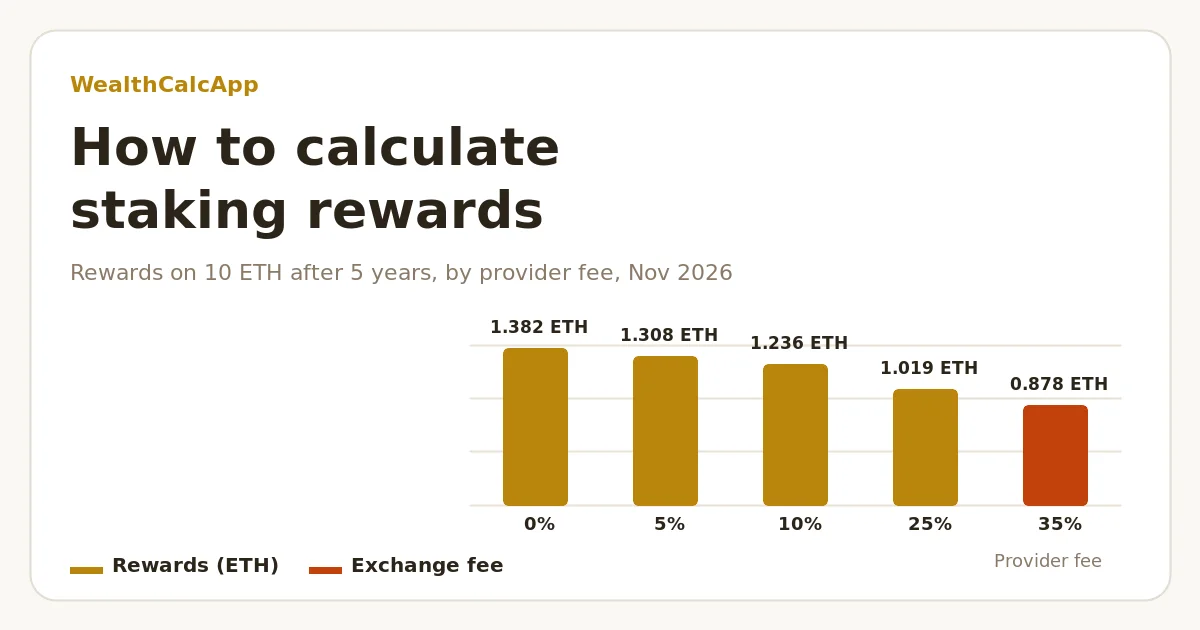
Using the gross rate behind Lido’s figure, about 2.59%, here is what 10 ETH earns over five years with daily compounding:
| Provider fee | Net APR | Rewards after 5 years | At $2,019 per ETH |
|---|---|---|---|
| 0% (solo validator) | 2.59% | 1.382 ETH | $2,790 |
| 5% | 2.46% | 1.308 ETH | $2,642 |
| 10% (Lido) | 2.33% | 1.236 ETH | $2,495 |
| 25% | 1.94% | 1.019 ETH | $2,059 |
| 35% | 1.68% | 0.878 ETH | $1,772 |
A 35% commission costs more than a third of your rewards, about $1,000 over five years on this stake. On Solana, where you delegate to a validator of your choice, commissions are visible on-chain: on 12 November 2026 the median active validator charged 5%, and about a third charged nothing on inflation rewards. A 0% validator is not automatically the best choice, though, as an unreliable one can miss votes and earn less.
Where the yield comes from, and why inflation shrinks it
Most staking rewards are newly issued tokens. That makes them different from bank interest: when everyone stakes, the network is mostly paying holders in their own diluted currency. The useful measure is your share of the total supply, which grows only if your rewards beat the issuance rate:
| Network, 12 Nov 2026 | Supply inflation | Share of supply staked | Net reward | Real yield |
|---|---|---|---|---|
| Solana (5% commission) | 3.56% | 68.0% | 4.97% | 1.37% |
| Ethereum (Lido) | about 0.91% before fees are burned | 36.5% | 2.33% | about 1.41% |
Solana’s protocol issues new SOL at 3.56% a year and splits it among stakers, which is why the gross rate is about 3.56% ÷ 68% = 5.24%. Stake 100 SOL with a 5% validator and you get about 4.97 SOL a year, but your slice of the network grows only 1.37%. If you hold without staking, your share shrinks by 3.4% a year. On Ethereum, issuance falls as more ETH is staked: the reward rate is roughly 166 ÷ √(total ETH staked), which with 44.6 million ETH staked gives about 2.5%, while part of transaction fees is burned and offsets some of the new supply.
So staking is often less a way to earn and more a way to avoid being diluted. That is a reasonable thing to do, but it is not the same as a 5% return.
Token price: the reward is the small part of the result
Ten staked ETH grow to 10.236 ETH after a year at 2.33%. What that is worth depends on the price, and a single month of normal crypto volatility moves it more than a year of rewards. Measured in dollars from a $20,193 starting value, as you would in a crypto profit calculation:
| ETH price after one year | Value of 10.236 ETH | Result in dollars |
|---|---|---|
| −50% ($1,010) | $10,335 | −$9,858 (−48.8%) |
| −30% ($1,414) | $14,468 | −$5,725 (−28.3%) |
| −10% ($1,817) | $18,602 | −$1,591 (−7.9%) |
| Unchanged ($2,019) | $20,669 | +$476 (+2.4%) |
| +10% ($2,221) | $22,736 | +$2,543 (+12.6%) |
| +30% ($2,625) | $26,870 | +$6,677 (+33.1%) |
The useful number here is the break-even price, the level at which extra tokens exactly offset a fall:
For this stake that is $1,973 after one year and $1,797 after five. Rewards give you a cushion of about 2% a year against a falling price, and nothing more. Staking a token you would not hold anyway, just for the yield, is a price bet with a small coupon attached.
Lock-ups, exit queues and slashing
A yield you cannot leave quickly is worth less than the same yield in an account you can empty today. Before staking, find out how long it takes to get your tokens back:
- Ethereum native staking: exits wait in a queue. On 12 November 2026 the exit queue was about 5 days and 16 hours, plus a withdrawal sweep of about 7 days, so nearly two weeks. During the October 2026 rush it was longer. New deposits waited about 16 days to start earning.
- Solana: deactivating stake takes until the end of the current epoch, roughly two days.
- Liquid staking tokens: you can usually sell stETH or similar tokens at once, but in a panic they can trade below the value of the ETH behind them.
- Exchange staking: some products have fixed terms; others let you unstake at any time but hold your coins in the exchange’s custody.
Slashing, a penalty for validators that sign conflicting messages, is rare for well-run operators but is a real risk if you or your provider gets it wrong. Custody risk is often bigger: tokens staked on an exchange are only as safe as the exchange, which is why our crypto wallets guide and the comparison of staking vs lending are worth reading before you choose.
How staking rewards are taxed in the US in 2026
Under IRS Revenue Ruling 2023-14, staking rewards are ordinary income when you gain “dominion and control” over them, meaning when you can sell or move them. You report their fair market value in dollars at that moment, whether or not you sell. That value becomes the cost basis of the new tokens:
Later gain or loss = Sale proceeds − That same value
The 0.236 ETH from the example, received while ether is around $2,019, is about $476 of income, roughly $105 of federal tax at a 22% bracket. If ether then drops 30% before you sell, those tokens are worth $143 less than the value you were taxed on. You can claim that as a capital loss, but you still paid income tax first, and capital losses offset only $3,000 of ordinary income a year.
Rewards received daily mean hundreds of small income events a year, each with its own price and holding period. Brokers do not report staking rewards on Form 1099-DA, so keep a record of every payout or export it from your provider. A House bill to let stakers defer this tax until sale was proposed in 2026, but the deferral was dropped in committee in September, so the rule above still applies. See our crypto tax guide for the reporting side. To estimate the tax on a later sale of the rewards, use the crypto tax calculator with the value at receipt as your purchase price.
Limits worth knowing
- Rates move. Ethereum’s rate falls as more ETH is staked, and fee and MEV income varies week to week. A 7-day average is a snapshot, not a promise.
- Calculators assume a flat rate and price. Real rewards vary each day, and a single price change assumption is a scenario, not a forecast.
- High yields have a source. Small tokens paying 15% or more usually do it with high inflation; work out the real yield before you are impressed.
- Tax rules differ and change. The treatment above is for the US. Other countries tax rewards at receipt, at sale, or under special rules, and state taxes come on top.
- This is not advice. The figures here show how the maths works on 12 November 2026; they say nothing about whether ETH or SOL is a good investment.
References
- ethereum.org — Ethereum staking: solo, pooled and liquid staking explained
- IRS — Revenue Ruling 2023-14: tax treatment of staking rewards
- Wikipedia — Proof of stake
Frequently asked questions
Passionate about finance and investing, with more than 6 years of hands-on experience in the crypto world. He shares analysis and financial education on his YouTube channel, Cripto Adicto.
Watch on YouTube →Keep reading

Calculate your staking rewards
Enter your tokens, the net reward rate, the price and how often rewards are restaked to see rewards, total value and effective APY year by year.
Open the Staking Calculator →