APR vs APY: The Rate You’re Quoted and the Rate You Actually Get


Banks quote two different numbers for the same thing, and they pick whichever one looks better. Savings accounts advertise their APY, which includes the effect of compounding and is the higher figure. Loans and credit cards lead with their APR, which leaves compounding out and is the lower one. Neither is a trick in itself, but you can’t compare a savings rate, a card balance and a crypto staking reward until you know which number you are looking at. This guide explains both, shows how to convert one into the other, and works through real examples for savings, a personal loan, a credit card and a staking reward. The figures use the same maths as our compound interest calculator.
APR vs APY: the short answer
APR (annual percentage rate) is the yearly rate before compounding. On a loan it also folds in some of the fees you pay to take it out. APY (annual percentage yield) is the rate after compounding: what a balance really grows by in a year once interest starts earning interest.
| APR | APY | |
|---|---|---|
| Includes compounding? | No | Yes |
| Includes fees? | Some lender fees, on loans | No |
| Usually quoted on | Loans, mortgages, credit cards | Savings, CDs, money market accounts |
| Who it flatters | The lender (looks lower) | The bank (looks higher) |
| US law requiring it | Truth in Lending Act | Truth in Savings Act |
The rule of thumb follows from that: when you borrow, look for the lowest APR; when you save, look for the highest APY. The trouble starts when you compare across the two, or when a product quotes the “wrong” one for its category, which is common in crypto.
How compounding turns an APR into an APY
Interest compounds when it is added to your balance and starts earning (or costing) interest itself. The more often that happens, the further the APY moves above the APR:
Monthly example: (1 + 0.05 ÷ 12) ^ 12 − 1 = 0.0512 → 5.12% APY
Back the other way: APR = [PERIODS] × ((1 + [APY]) ^ (1 ÷ [PERIODS]) − 1)
| 5% APR compounded… | APY | 22% APR compounded… | APY |
|---|---|---|---|
| Annually | 5.00% | Annually | 22.00% |
| Quarterly | 5.09% | Quarterly | 23.88% |
| Monthly | 5.12% | Monthly | 24.36% |
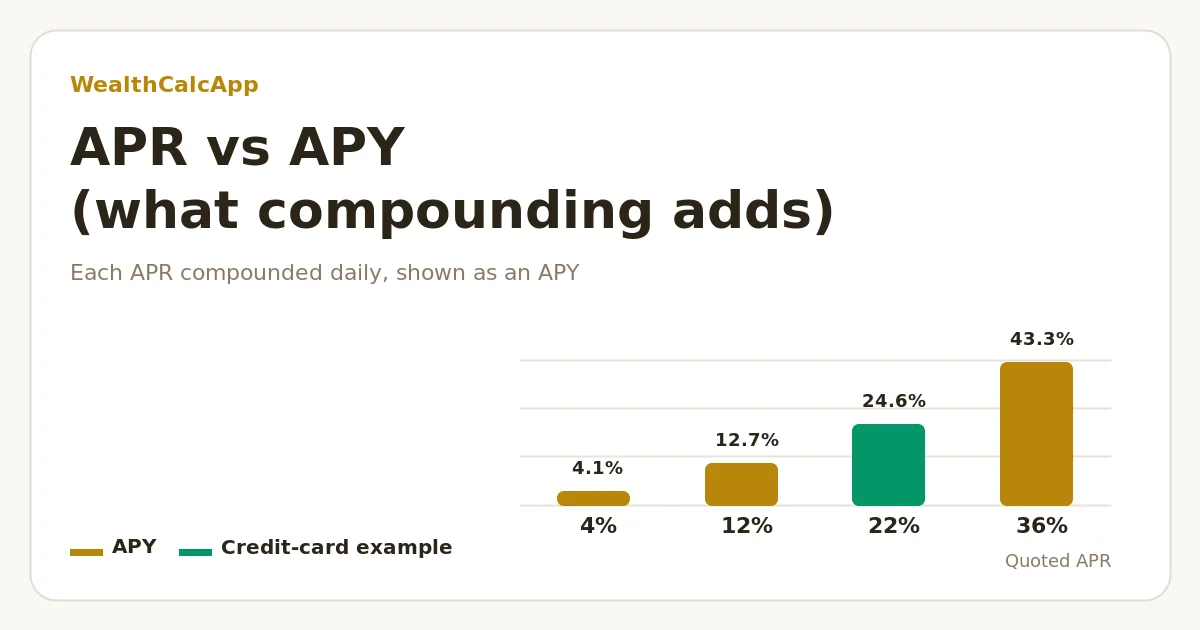
| Daily | 5.13% | Daily | 24.60% |
Two things stand out. First, at savings-account rates the frequency barely matters: daily rather than monthly compounding adds about a hundredth of a point. Second, at credit-card rates it matters a lot: compounding adds more than two and a half points to a 22% APR. The gap grows with the rate, which is why it is a rounding error on your savings and a real cost on your debts.
In a spreadsheet you don’t need the formula. Excel, Google Sheets and LibreOffice all have two built-in functions:
=NOMINAL([APY AS A DECIMAL], [PERIODS PER YEAR]) → APR. =NOMINAL(0.04, 12) returns 0.0393
Savings accounts: what the APY really pays
Because US banks must quote APY on deposit accounts, comparing savings accounts is the easy case: the APY already includes compounding, so the higher number wins. What surprises people is how little the compounding frequency adds compared with the rate itself.
| $10,000 left for 10 years at… | Balance | Interest |
|---|---|---|
| 4.00% APY | $14,802 | $4,802 |
| 4.00% APR, compounded monthly (4.07% APY) | $14,908 | $4,908 |
| 4.50% APY | $15,530 | $5,530 |
Monthly rather than annual compounding at the same headline rate is worth about $106 over a decade. Half a point more APY is worth $728. Chase the rate, not the compounding schedule. Our guide to the best high-yield savings accounts covers the other filters that matter more than either: FDIC insurance, fees and promotional rates.
Three things the APY doesn’t tell you:
- It is usually variable. A savings APY can be cut the week after you open the account. Only a CD locks the rate for a term.
- It may have conditions. “Up to 5% APY” often applies only to the first few thousand dollars, or only if you pay in a salary every month.
- It is before tax and inflation. At 4% APY, a saver in the 24% federal bracket keeps 3.04%. If inflation runs at 3%, the real return is close to zero. And that gap compounds too.
You can open the monthly-compounding example in the compound interest calculator and switch between daily, monthly and annual compounding to see how little the frequency changes.
Loans: APR is interest plus fees
On a loan, APR has a second job. Under the Truth in Lending Act, lenders must include certain upfront charges, such as origination fees and mortgage points, in the APR. That makes it a better comparison tool than the interest rate alone, and it is why the APR on the same loan is usually the higher of the two figures.
Take a $20,000 personal loan over five years at a 10% interest rate, with a 5% origination fee taken out of the money you receive:
Money you actually receive = 20,000 − 5% fee = $19,000
APR = the rate at which 60 payments of $424.94 repay $19,000 → 12.24%
A loan advertised at 10% costs you 12.24% once the fee is counted, and a rival at 11.5% with no fee would be cheaper. The fee is also why repaying early hurts the fee loan more: you paid the whole fee upfront but only used the money for part of the term. The loan calculator shows the payment and total interest; our guide to the best personal loans covers what else to compare.
One subtlety: a US APR is the monthly rate multiplied by 12, so it still leaves out compounding. Converted to an APY, that 12.24% APR is 12.95%. For comparing two loans it makes no difference, as long as both are quoted the same way. In the EU, the equivalent figure, the APRC, already includes compounding, so European loan rates look slightly higher than an identical US loan’s APR.
Credit cards: why a 22% APR costs more than 22%
Most US credit cards charge interest daily. The issuer divides the APR by 365 to get a daily rate, applies it to your balance each day and adds the interest to what you owe, so tomorrow’s interest is charged on today’s interest. That is daily compounding, and it is not shown in the APR.
$5,000 left unpaid for a year = 5,000 × ((1 + 0.22 ÷ 365) ^ 365 − 1) = $1,230 of interest
The APR alone suggests 5,000 × 22% = $1,100. Effective rate: 24.6%
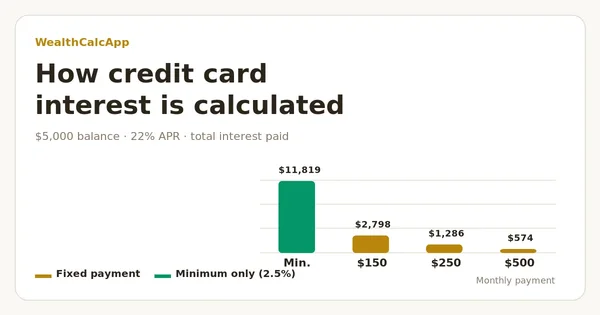
If you pay in full every month, none of this matters: the grace period means you pay no interest at all. It matters as soon as you carry a balance. Paying a fixed $250 a month, that $5,000 takes 26 months to clear and costs about $1,286 in interest, which you can check in the credit card payoff calculator. Paying only the minimum takes years longer.
Watch two other card rates as well. Cash advances usually carry a higher APR and no grace period, so interest starts on day one. And 0% intro APR offers are genuinely useful for paying debt down, as long as you clear it before the offer ends and the standard rate applies. Our guide on how to pay off debt fast shows how to use them without getting caught.
Crypto staking and DeFi: APR, APY and the yield you keep
Crypto platforms use APR and APY loosely, and there is no Truth in Savings Act to keep them honest. Before you compare two offers, check three things.
- Which number is it? A 20% APR paid and restaked daily is a 22.1% APY. A platform that shows APY for its own product and APR for a rival’s is making itself look better.
- Does compounding actually happen? An APY assumes rewards are added back and earn rewards themselves. If rewards are paid out to a separate balance, or restaking costs a network fee each time, you get closer to the APR.
- What is it paid in? Staking rewards are paid in the token you staked. A 20% yield on a token that falls 30% is a loss.
After a year: 10 × (1 + 0.20 ÷ 365) ^ 365 = 12.21 tokens (22.1% APY)
If the price falls to $70: 12.21 × 70 = $855 → a loss of 14.5% despite the yield
Be particularly sceptical of three-digit DeFi yields. A 100% APR compounded daily becomes a 171.5% APY, which is why headline figures in that range are usually quoted as APY. They are often paid in a newly issued reward token whose price falls as more is created. Our article on staking vs lending covers where the yield really comes from, and the staking calculator lets you add a price change to the example above.
How to compare any two rates: a five-point checklist
- Put both on the same basis. Convert APR to APY (or the reverse) with EFFECT or NOMINAL before you compare. This is the step most comparisons skip.
- Count every fee. For a loan, the APR includes the upfront fees; for a savings account or a crypto platform, monthly fees, withdrawal fees and network costs come out of the APY.
- Check how long the rate lasts. Teaser APYs and intro APRs expire. Compare what you would earn or pay over the whole period you will actually hold the product.
- Take tax and inflation off. After-tax real yield ≈ APY × (1 − [YOUR TAX RATE]) − [INFLATION RATE]. It turns a 4% headline into almost nothing in a high bracket.
- Look at the money, not just the percentage. Run the actual amounts: dollars earned on savings, total repaid on a loan. Small rate differences on small balances are rarely worth switching for; on a mortgage or a large card balance they are.
Convert B: =EFFECT([RATE B]/100, [N]) → compare with [RATE A]/100
Then subtract any monthly fee: fee × 12 ÷ [BALANCE] = the yield the fee costs you
Limits worth knowing
- APY assumes nothing changes. It is the yield if the rate stays the same and the money stays put for a full year. Variable rates, withdrawals and deposits all change the result.
- APR doesn’t include every cost. Late fees, penalty APRs and optional insurance are not in it, and on a mortgage it leaves out costs such as title insurance and appraisals that are not lender fees.
- A US APR ignores compounding. Fine for comparing two US loans, misleading if you compare it with a savings APY or with an EU APRC.
- Neither number measures risk. A 4% FDIC-insured account and a 4% yield from a crypto lender are not the same offer. Several lenders that paid high yields collapsed in 2022 and customers lost access to their funds.
- Our calculators simplify. The savings calculator takes the rate as an APY and compounds monthly; the loan and credit card calculators apply the rate divided by 12 each month, so they slightly understate interest on a card that compounds daily. Treat the results as estimates.
References
- Consumer Financial Protection Bureau — What is the difference between a mortgage interest rate and an APR?
- Wikipedia — Annual percentage yield
- Wikipedia — Annual percentage rate
Frequently asked questions
Passionate about finance and investing, with more than 6 years of hands-on experience in the crypto world. He shares analysis and financial education on his YouTube channel, Cripto Adicto.
Watch on YouTube →Keep reading



Turn any rate into real money
Enter a balance, a rate and how often it compounds to see what an APR or APY means in dollars over the years you plan to save or borrow.
Open the Compound Interest Calculator →