
How to Calculate Crypto Profit: Fees, Cost Basis and the Number the IRS Sees


Your exchange app shows a green or red number next to each coin, but that figure is rarely your real profit. It usually ignores the fees you paid, averages purchases the tax rules may treat separately, and counts nothing until you sell. In November 2026, with bitcoin at about $74,300 after trading above $110,000 a year ago, many holders are sitting on losses they do not fully understand. This guide shows how to calculate crypto profit properly: the formula with fees, the price you need just to break even, what happens when you bought at several prices, why swapping one coin for another counts as selling, and how the result turns into the gain or loss you report to the IRS.
The formula: what you received minus everything you paid
Profit on a crypto trade is the money that came out minus the money that went in, with fees on both sides. Price change alone is not profit:
Net proceeds = [UNITS SOLD] × [SELL PRICE] − [SELL FEES]
Profit = Net proceeds − Cost of the units sold
Return = Profit ÷ Cost × 100
Take a $2,000 purchase of bitcoin on 15 July 2026 at $64,690, through an app charging 1% each way. The fee is $20, so $1,980 buys 0.030608 BTC. Sold on 10 November 2026 at $74,317, the coins fetch $2,274.66, minus a $22.75 fee, leaving $2,251.91.
| Step | Amount |
|---|---|
| Money paid in (including $20 buy fee) | $2,000.00 |
| Bitcoin received | 0.030608 BTC |
| Sale value at $74,317 | $2,274.66 |
| Sell fee (1%) | −$22.75 |
| Net proceeds | $2,251.91 |
| Profit | $251.91 |
| Return on the $2,000 | 12.6% |
The price rose 14.9%, but the return was 12.6%: fees took about a sixth of the gain. You can rerun this example in the crypto profit calculator, which adds both fees to the cost, and compare it with other investments using the ROI formula.
Your break-even price, and why fees matter more than they look
Before worrying about profit, work out the price at which you stop losing money. It is not the price you paid:
In the example that is $2,000 ÷ (0.030608 × 0.99) = $66,003, about 2% above the $64,690 purchase price. With a spread on top, which many “simple buy” buttons hide inside the quoted price, it can be higher. The round-trip cost compounds quickly if you trade often:
| Fee each way | Round trip on $1,000 | Price rise needed to break even | Lost to fees after 12 round trips |
|---|---|---|---|
| 0.1% (exchange order book, low tier) | $2.00 | 0.2% | 2.4% |
| 0.6% (exchange, taker) | $11.96 | 1.2% | 13.4% |
| 1.5% (app or card purchase) | $29.78 | 3.1% | 30.4% |
| 2.0% (fee plus spread) | $39.60 | 4.1% | 38.4% |
An active trader paying 2% a side gives away more than a third of their money in a year of monthly round trips, before any market move. If you buy regularly, the cheapest order type on the same exchange is usually worth the extra click.
Several purchases: average cost, FIFO and specific lots
Most people do not buy once. Suppose you put $1,000 into bitcoin on four dates, as in a dollar-cost averaging plan:
| Purchase date | Price | Bitcoin bought |
|---|---|---|
| 15 April 2025 | $85,568 | 0.011687 |
| 15 October 2025 | $112,009 | 0.008928 |
| 15 January 2026 | $96,562 | 0.010356 |
| 15 July 2026 | $64,690 | 0.015458 |
| Total | $4,000 invested | 0.046429 BTC |
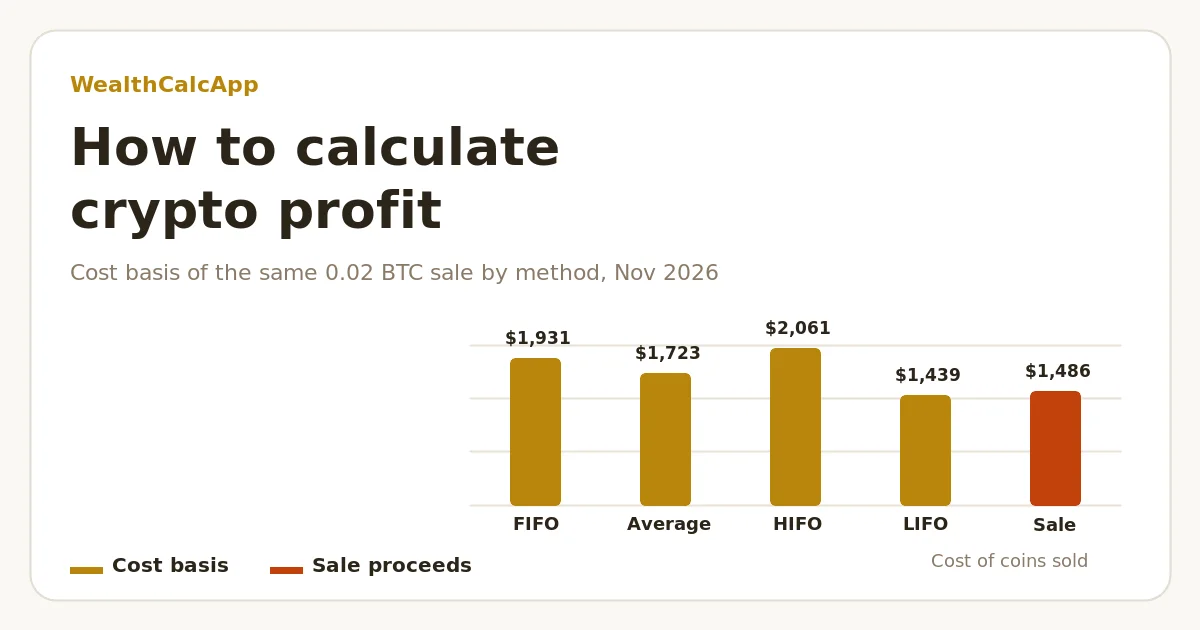
Your average cost is $4,000 ÷ 0.046429 = $86,153 per bitcoin. At $74,317 the holding is worth $3,450, an unrealised loss of $550, or 13.7%. That is the figure your app shows. Now sell 0.02 BTC for $1,486. The profit depends entirely on which coins you say you sold:
| Method | Coins treated as sold | Cost basis | Result |
|---|---|---|---|
| FIFO (first in, first out) | April and part of October 2025 | $1,931 | −$445 |
| Average cost | A slice of every purchase | $1,723 | −$237 |
| Highest cost first | October 2025, January 2026, a little of April | $2,061 | −$575 |
| LIFO (last in, first out) | July 2026 and part of January | $1,439 | +$48 |
Same coins, same day, same price: a result anywhere from a $575 loss to a $48 profit. For your own tracking, average cost is a fair picture of how the whole position is doing. For tax, the IRS does not accept average cost for crypto. You may pick specific units only if you identify them by the time of the sale, in the records of the wallet or account they sit in; otherwise the default is FIFO within that wallet or account.
Realised vs unrealised: why your app and your tax form disagree
An unrealised gain or loss is the paper result on coins you still hold: today’s value minus their cost. It moves every minute and has no tax effect. A realised result is locked in when you dispose of coins, and only that part goes on your return.
Apps and tax forms often disagree for three reasons:
- Transfers break the history. If you move coins from one exchange to another, the receiving platform does not know what you paid and may show a cost of zero or the price on the day they arrived.
- Different methods. The app may average all your purchases while the tax report uses FIFO or the lots you chose.
- Fees paid in crypto. A network fee paid in ETH is itself a small disposal of ETH, and some apps ignore it.
Since 2025, US brokers have reported gross proceeds of your sales on the new Form 1099-DA, and for many assets bought from 1 January 2026 they also report cost basis. Coins you moved in from a personal wallet or another platform usually arrive without basis, so keep your own purchase records: the IRS will see the sale price either way.
Swaps, stablecoins and paying with crypto count as selling
Exchanging one coin for another is a disposal of the first coin at its market value, even though no dollars touch your bank account. The same applies to buying a stablecoin, paying for something with crypto or swapping tokens on a decentralised exchange.
Example: on 15 April 2026 you swap 0.01 BTC bought in January at $96,562 for ether, when bitcoin trades at $74,229. You have sold bitcoin for $742.29 and realised a $223.33 loss, and you now own 0.31907 ETH with a cost basis of $742.29. At $2,092 that ether is worth $667, a further unrealised loss of $75 that only counts when you sell or swap again.
Cost basis of the new coin = Same USD value (+ any fee you paid to acquire it)
Moving coins between your own wallets is not a disposal, but a network fee paid in crypto technically is. Coins received as staking, mining or airdrop rewards count as income at their value when you receive them, and that value becomes their cost basis.
Percentage losses and the recovery trap
Percentages are not symmetric. A fall of a given size needs a much larger rise to get back to where you started:
| Loss | Rise needed to recover |
|---|---|
| −10% | +11.1% |
| −20% | +25.0% |
| −30% | +42.9% |
| −50% | +100% |
| −75% | +300% |
| −90% | +900% |
Bitcoin fell from about $112,000 in October 2025 to $74,317 this month, a 34% drop that needs a 51% rise just to recover. Many smaller tokens have lost 75% or more, which needs a quadrupling. When you judge a position, compare it with your cost, not with the peak, and keep in mind that “averaging down” into a falling coin raises your exposure along with lowering your average price.
From profit to tax: what the IRS counts in 2026
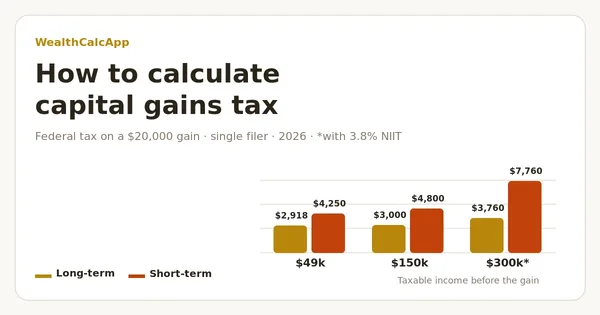
The IRS treats crypto as property, so each realised result is a capital gain or loss reported on Form 8949 and Schedule D. How it is taxed depends on how long you held the coins; our guide to calculating capital gains tax walks through the brackets.
- One year or less: short-term, taxed at your ordinary income rate of 10% to 37%. The $251.91 profit in the first example would cost about $55 at a 22% bracket.
- More than one year: long-term, taxed at 0%, 15% or 20%. For 2026 the 0% rate applies to single filers with taxable income up to $49,450; the 3.8% net investment income tax can apply above $200,000.
- Losses: they first offset gains, then up to $3,000 a year of ordinary income ($1,500 if married filing separately). The rest carries forward with no time limit.
In the four-purchase example, the FIFO sale realises a $445 loss on coins held for more than a year, so it is a long-term loss. Unlike shares, crypto is not currently covered by the wash sale rule, so you can sell at a loss and buy back straight away; Congress has considered bills to change that, so check the rule in the year you trade. You can estimate the tax on any sale with the crypto tax calculator, set here to the first example as a short-term gain.
Limits worth knowing
- Records are everything. Without dates, amounts and prices for every purchase you cannot prove your cost basis, and a missing basis can be treated as zero.
- Prices differ between platforms. Use the price on the exchange where the trade happened, or a consistent reputable source for swaps and rewards.
- Calculators simplify. A single-trade calculator assumes one purchase and one sale; it cannot apply lot rules, holding periods or staking income for you.
- Tax rules change. Broker reporting, wash sale proposals and state taxes all affect the final figure. Our crypto tax guide covers the reporting side, and a tax professional is worth it for large or complicated histories.
- Profit is not the same as performance. A 12% gain over four months and over four years are very different results. To compare them, annualise the return or use the money-weighted return of your whole plan.
References
- IRS — Digital assets: taxable events, basis and broker reporting on Form 1099-DA
- IRS — Frequently asked questions on digital asset transactions (specific identification and FIFO)
- Wikipedia — Cost basis
Frequently asked questions
Passionate about finance and investing, with more than 6 years of hands-on experience in the crypto world. He shares analysis and financial education on his YouTube channel, Cripto Adicto.
Watch on YouTube →Keep reading

Calculate your crypto profit
Enter your buy price, sell price, amount and fees to see your net profit, return and break-even price.
Open the Crypto Profit Calculator →