
Marginal vs Effective Tax Rate: What Your Next Dollar Really Costs


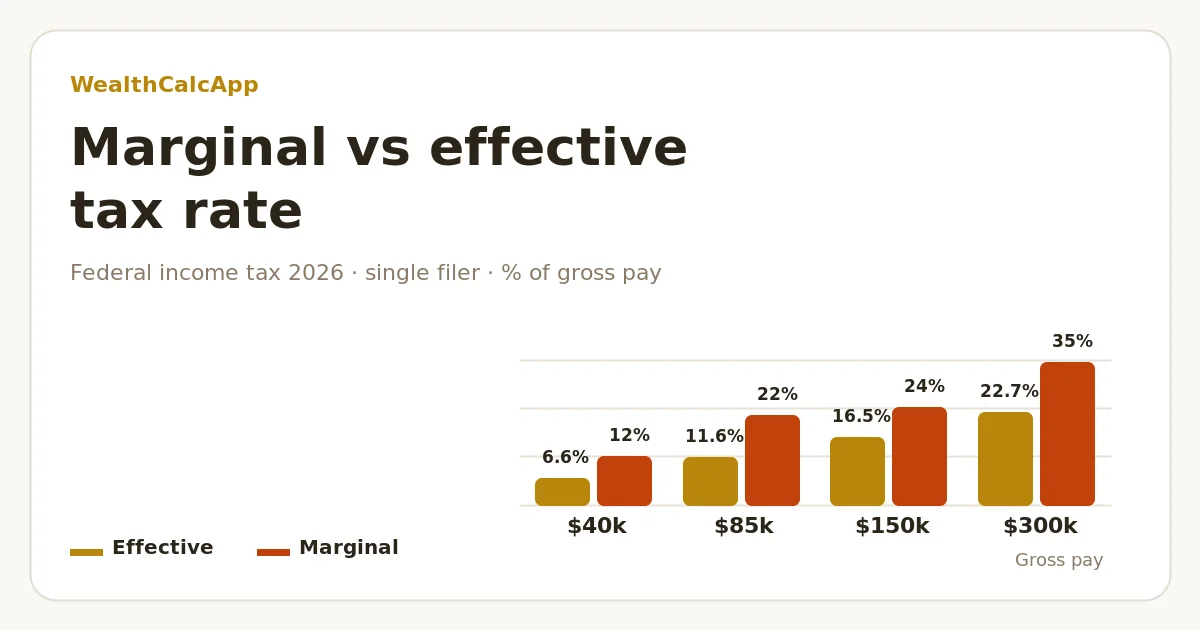
Ask people what tax rate they pay and most will name their bracket: “I’m in the 22% bracket.” That number matters, but it is not what you pay. A single filer earning $85,000 in 2026 is in the 22% bracket, yet their federal income tax comes to about 11.6% of their salary. The first number is the marginal rate, the tax on your next dollar. The second is the effective rate, the share of your income that actually goes in tax. Mixing them up leads to real mistakes: turning down a raise, undervaluing a 401(k) contribution or budgeting with the wrong net income. This guide shows how to calculate both with the 2026 brackets, what your true marginal rate is once payroll and state taxes are added, and which rate answers which question.
Two rates that answer two different questions
Both rates come from the same tax bill, but they measure different things:
Effective rate = [TOTAL TAX] ÷ [INCOME] × 100 (the average rate on all of it)
- Marginal rate answers “how much of an extra dollar do I keep?” It is the rate of the bracket your last dollar of taxable income falls into, plus any other tax that rises with income.
- Effective rate answers “how much of my income goes in tax overall?” It is always lower than the top marginal rate, because the first slices of income are taxed at lower rates or not at all.
One detail causes most of the confusion between sources: the denominator. Some calculate the effective rate on taxable income (after the standard deduction), others on gross income. Both are legitimate, but they give different numbers, so say which one you are using. For budgeting and comparing job offers, gross income is the more useful base.
How brackets work: a worked example with 2026 figures
Federal income tax is progressive. Each bracket applies only to the slice of taxable income inside it. For a single filer in 2026, the brackets are 10% up to $12,400, 12% up to $50,400, 22% up to $105,700, 24% up to $201,775, 32% up to $256,225, 35% up to $640,600 and 37% above that. The standard deduction is $16,100.
Take a single filer with a salary of $85,000 and no other income or deductions:
- Subtract the standard deduction: $85,000 − $16,100 = $68,900 of taxable income.
- Tax each slice at its own rate, as in the table below.
- Add the slices and divide by income to get the effective rate.
| Slice of taxable income | Rate | Tax on the slice |
|---|---|---|
| $0 – $12,400 | 10% | $1,240 |
| $12,400 – $50,400 | 12% | $4,560 |
| $50,400 – $68,900 | 22% | $4,070 |
| Total federal income tax | $9,870 |
The marginal rate is 22%: that is where the last dollar lands. The effective rate is $9,870 ÷ $68,900 = 14.3% of taxable income, or $9,870 ÷ $85,000 = 11.6% of gross pay. The same method works at any income:
| Gross pay (single, 2026) | Federal income tax | Effective rate (on gross) | Marginal rate |
|---|---|---|---|
| $40,000 | $2,620 | 6.6% | 12% |
| $60,000 | $5,020 | 8.4% | 12% |
| $85,000 | $9,870 | 11.6% | 22% |
| $150,000 | $24,734 | 16.5% | 24% |
| $300,000 | $68,134 | 22.7% | 35% |
If you are paid by the hour, convert to an annual figure first; our guide to converting hourly pay to salary covers overtime and unpaid weeks. The salary calculator does the conversion in either direction.
Why moving into a higher bracket never lowers your pay
The most expensive tax myth is that a raise can “push you into a higher bracket” and leave you worse off. It cannot, because the higher rate only applies to the dollars above the threshold. Everything below keeps its old rate.
Suppose the $85,000 earner gets a $5,000 raise. All $5,000 falls in the 22% bracket, so federal income tax rises by $1,100 and FICA by $382.50. They keep $3,517.50, or 70 cents of every extra dollar. Now push further: taxable income reaches the 24% bracket at $105,700, which for a single filer means a gross salary of $121,800. Earning $1,000 more than that costs $240 in federal tax on that $1,000, not 24% of the whole salary.
Kept from the raise = [RAISE] × (1 − combined marginal rate)
There are narrow cases where an extra dollar costs more than a dollar, but they come from benefits and credits with hard cut-offs (some health insurance subsidies or means-tested programmes), not from the brackets themselves. If you are near one of those limits, check that specific rule rather than avoiding the raise.
Your real marginal rate: FICA, state tax and phase-outs
Your bracket is only the federal income tax part. On a paycheck, each extra dollar of wages also pays:
- FICA: 7.65% (6.2% Social Security plus 1.45% Medicare). Social Security stops at the 2026 wage base of $184,500; Medicare does not, and an extra 0.9% applies to wages above $200,000 for a single filer.
- State and local income tax: nothing in states such as Texas or Florida, a flat rate in others (Illinois charges 4.95%), and progressive brackets in most.
- Phase-outs: some credits and deductions shrink as income rises, which works like an extra hidden rate. The earned income tax credit falls by 15.98% of each extra dollar for a parent with one child and 21.06% with two or more. The child tax credit is reduced above $200,000 of income ($400,000 jointly), and the $6,000 senior deduction for 2025–2028 phases out above $75,000 ($150,000 jointly).
| Single filer, $85,000 salary | Rate on the next dollar |
|---|---|
| Federal income tax | 22% |
| FICA | 7.65% |
| State tax (Illinois flat rate) | 4.95% |
| Combined marginal rate | 34.6% |
So the realistic marginal rate for many middle earners is 30% to 40%, not 22%. Our guide to take-home pay and withholding shows how these deductions appear on each paycheck.
Deductions save at your marginal rate, credits save in full
This is where the marginal rate earns its keep. A deduction lowers taxable income, so it saves tax at your marginal rate. A credit is subtracted from the tax itself, so it saves its full amount:
Tax saved by a credit = [CREDIT]
Our $85,000 earner puts $5,000 a year into a traditional 401(k). Taxable income falls from $68,900 to $63,900, all within the 22% bracket, so federal income tax falls by $1,100. The $5,000 contribution costs them $3,900 of take-home pay (FICA still applies to 401(k) deferrals). A $1,000 credit, by contrast, is worth $1,000 whatever your bracket. You can see how that contribution grows over 30 years in the retirement calculator, and compare account types in our guide to the best retirement accounts.
The same logic explains why itemised deductions are worth more to high earners: $1,000 of deductions saves $350 at a 35% rate and $120 at a 12% rate. It also explains a common trap: if your deduction pulls income down into a lower bracket, the part below the threshold only saves at the lower rate.
Which rate to use for which decision
Most financial questions need one rate or the other, rarely both:
| Decision | Rate to use | Why |
|---|---|---|
| Budgeting your monthly spending | Effective (on gross) | It tells you what share of your whole salary is gone |
| Comparing two job offers | Effective, then marginal on the difference | Base pay first, then what you keep from the extra |
| A raise, bonus or overtime | Combined marginal | Only the extra dollars are affected |
| Traditional 401(k) or IRA deduction | Marginal now | The deduction comes off the top of your income |
| Roth or traditional | Marginal now vs your expected rate on withdrawals | You pay tax now or later; compare the two |
| Side income | Marginal plus self-employment tax | It is stacked on top of your salary |
Side income deserves a special mention: freelance profit pays self-employment tax of 15.3% on top of income tax, so a 22% bracket becomes roughly 36% before state tax. Our self-employment tax guide explains the calculation and the half that you can deduct.
Married couples and second incomes
Filing jointly doubles most bracket thresholds: in 2026 the 22% bracket runs from $100,800 to $211,400 of taxable income, and the standard deduction is $32,200. A couple earning $170,000 between them has $137,800 of taxable income and pays $19,740 in federal income tax, an effective rate of 11.6% of gross, with a marginal rate of 22%.
Here is the catch for a second earner. On a joint return, their first dollar is taxed at the household’s marginal rate, not from zero. If one spouse earns $120,000 and the other is deciding whether to take a $50,000 job, the new salary is taxed at 12% and 22% from its first dollar, plus FICA, plus any childcare costs. That does not make the job a bad idea, but the net gain is smaller than a quick look at the effective rate suggests.
Withholding also gets this wrong. Each employer withholds as if its salary were the only one, which tends to under-withhold for two-earner couples. Use the IRS withholding estimator or the two-jobs section of Form W-4 to fix it.
Limits worth knowing
- Brackets apply to taxable income. Your effective rate depends on deductions, credits and the mix of income, so two people with the same salary can have very different effective rates.
- Investment income has its own rates. Long-term capital gains and qualified dividends are taxed at 0%, 15% or 20%, stacked on top of your ordinary income; see our guide to calculating capital gains tax.
- Marginal rates are not constant. Phase-outs and benefit cut-offs create zones where the rate jumps, so a figure that is right at $85,000 may be wrong at $95,000.
- The figures change each year. Bracket thresholds are adjusted for inflation every autumn; these numbers are for tax year 2026.
- This is an estimate, not tax advice. For a complicated return, a tax professional or the IRS tools give the authoritative figure.
References
- IRS — Tax inflation adjustments for tax year 2026 (brackets and standard deduction)
- IRS — Federal income tax rates and brackets
- Wikipedia — Tax rate: marginal and effective rates
Frequently asked questions
Passionate about finance and investing, with more than 6 years of hands-on experience in the crypto world. He shares analysis and financial education on his YouTube channel, Cripto Adicto.
Watch on YouTube →Keep reading

Turn your salary into real numbers
Convert hourly, weekly or monthly pay into an annual salary before you apply the brackets and work out your marginal and effective rate.
Open the Salary Calculator →