
How to Convert Hourly Pay to Salary: The Maths, Done Properly


“$25 an hour” and “$52,000 a year” describe exactly the same job, yet they feel different, and that gap trips people up when they compare offers, ask for a rise or set a freelance rate. The conversion itself is one multiplication. What changes the answer is everything around it: how many hours you really work, whether your time off is paid, how much overtime you get and what benefits come with the job. This guide gives you the formula, a conversion table for common rates, the shortcuts worth memorising and worked examples for the decisions where the numbers actually matter.
The hourly to salary formula
Annual pay is your hourly rate multiplied by the number of hours you are paid for in a year. For a standard full-time job that means 40 hours a week for 52 weeks, or 2,080 hours:
Standard full time: [HOURLY RATE] × 40 × 52 = [HOURLY RATE] × 2,080
At $25 an hour:
- Weekly pay: $25 × 40 = $1,000.
- Annual pay: $1,000 × 52 = $52,000.
- Monthly pay: $52,000 ÷ 12 = $4,333.
- Every two weeks (26 paychecks): $52,000 ÷ 26 = $2,000.
Notice the monthly step. A month is not four weeks: it is 52 ÷ 12 = 4.33 weeks on average. Multiplying a weekly wage by four gives $4,000 instead of $4,333, which is 7.7% too low and enough to wreck a budget. Always go through the annual figure, then divide by 12.
To check any rate against the formula, our salary calculator with $25 an hour filled in converts between hourly, weekly, monthly and yearly pay and lets you change the hours and paid weeks.
Common rates and quick shortcuts
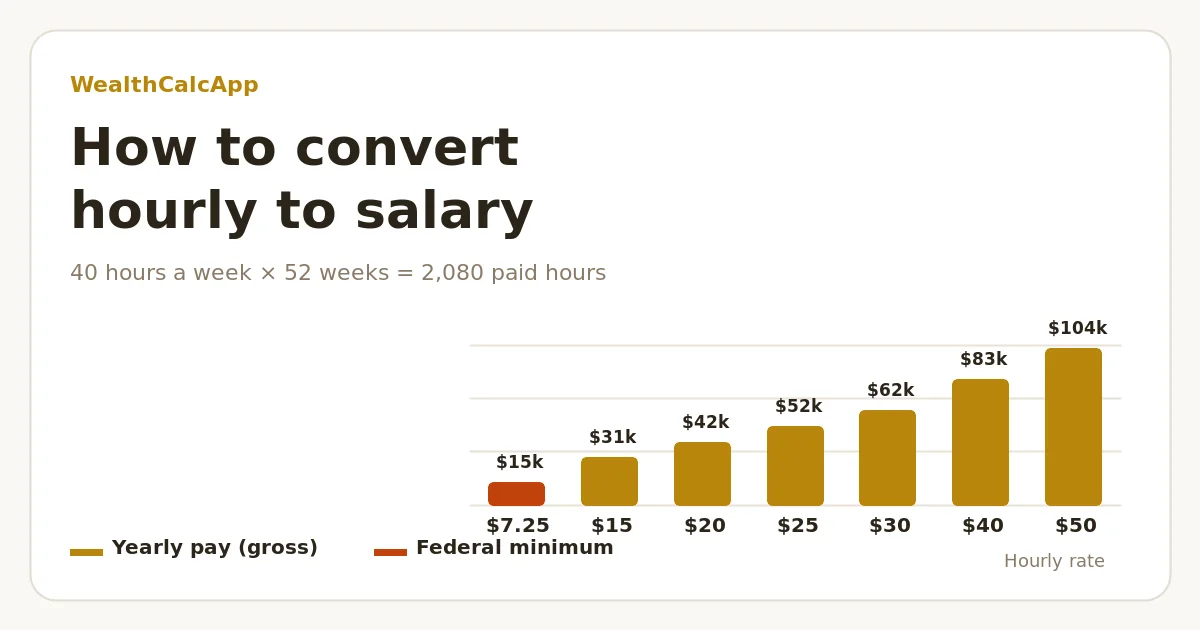
Here are common hourly rates turned into gross pay for a 40-hour week with every week paid:
| Hourly rate | Per year | Per month | Every two weeks |
|---|---|---|---|
| $7.25 (federal minimum) | $15,080 | $1,257 | $580 |
| $15 | $31,200 | $2,600 | $1,200 |
| $20 | $41,600 | $3,467 | $1,600 |
| $25 | $52,000 | $4,333 | $2,000 |
| $30 | $62,400 | $5,200 | $2,400 |
| $40 | $83,200 | $6,933 | $3,200 |
| $50 | $104,000 | $8,667 | $4,000 |
Three shortcuts cover most conversations without a calculator:
- Double it and add three zeros. $25 an hour is roughly $50,000 a year. It uses 2,000 hours instead of 2,080, so it is about 4% low; that slack is close to what two weeks of unpaid leave would cost you.
- Halve it and drop three zeros. The reverse: a $70,000 salary is about $35 an hour (the exact figure at 2,080 hours is $33.65).
- Each $1 an hour is about $2,080 a year. A $1.50 rise is worth $3,120 a year before tax, which is a more persuasive number when you negotiate.
For context, average hourly earnings across all US private-sector employees were $37.81 in September 2026, according to the Bureau of Labor Statistics, which is $78,645 a year at 2,080 hours. For production and non-supervisory workers the average was $32.60, or $67,808. The federal minimum of $7.25 has not changed since 2009, and many states and cities set a higher one.
Paid time off, holidays and the hours that count
The 2,080-hour formula assumes you are paid for every week of the year, including holidays and vacation. For most salaried jobs and many full-time hourly jobs that is true. For temps, gig workers, some part-time roles and every freelancer, it is not: time off is simply time without pay.
If your leave is unpaid, take it out of the hours before you multiply:
Annual pay = [HOURLY RATE] × [PAID HOURS]
Take a $25-an-hour worker who takes 10 days of vacation and 6 public holidays, none of them paid. That is 16 days × 8 hours = 128 hours, so paid hours fall from 2,080 to 1,952 and annual pay from $52,000 to $48,800. The same hourly rate is worth $3,200 less than it sounds.
There is also a calendar quirk. 2026 has 261 weekdays, which is 2,088 working hours rather than 2,080, and some years contain 27 biweekly paydays instead of 26. Hourly staff paid for every weekday earn slightly more in those years; salaried staff earn the same and simply see a smaller paycheck if the employer divides by 27.
Adding overtime (and why salaried hours matter)
Under the Fair Labor Standards Act, non-exempt employees must be paid at least one and a half times their regular rate for every hour over 40 in a workweek. Overtime is counted week by week, so a 45-hour week followed by a 35-hour week still includes 5 overtime hours.
At $25 an hour with 5 hours of overtime a week, weekly pay is $1,000 + 5 × $37.50 = $1,187.50. Over 50 weeks with overtime and 2 paid weeks at 40 hours, the year comes to $61,375, which is $9,375, or 18%, more than the straight 2,080-hour figure. Do not count on overtime in a salary comparison unless it has been regular for months.
Salaried employees are a different case. If you are paid at least $684 a week ($35,568 a year) and your duties count as executive, administrative or professional, you are probably exempt and get no overtime at all. That threshold was confirmed again in May 2026 after courts struck down the planned increase, and some states, such as California and New York, set higher ones. For exempt staff, long weeks quietly lower the hourly rate: a $60,000 salary looks like $28.85 an hour on 2,080 hours, but at 50 hours a week over 48 working weeks it is 2,400 hours and $25.00 an hour.
Salary to hourly: comparing two job offers
To turn a salary into an hourly rate, divide it by the hours you will actually work, not by the hours on paper:
Suppose you are choosing between two offers. Offer A is a salaried, exempt role at $62,000 where the team typically works 45 hours a week, with five weeks off between paid leave and holidays. Offer B pays $28 an hour for 40 hours with the same paid time off, plus about 3 hours of overtime a week on the 47 weeks worked:
| Offer A (salaried) | Offer B (hourly) | |
|---|---|---|
| Annual pay | $62,000 | $58,240 + $5,922 overtime = $64,162 |
| Hours actually worked | 47 × 45 = 2,115 | 47 × 43 = 2,021 |
| Real hourly rate | $29.31 | $31.75 |
The salaried job sounds better and pays less per hour of your life. That does not settle the decision on its own, because benefits differ more than pay. In June 2026 benefits made up 30.0% of what private employers spent on compensation, according to the BLS, so a better health plan or a 401(k) match can be worth more than the gap above. Put a dollar value on each, add it to the annual pay, and only then divide by the hours.
Setting a freelance or contract rate
Dividing an employee salary by 2,080 is the most common mistake freelancers make when they set a rate. As a contractor you pay both halves of Social Security and Medicare, buy your own benefits, cover your own costs and spend part of every week on work nobody pays for. Work backwards from what you need instead:
To match a $70,000 employee job:
- Target salary: $70,000.
- Health insurance and retirement contributions you now pay yourself: about $12,000.
- The employer half of Social Security and Medicare, 7.65%: $5,355.
- Software, equipment, insurance and accounting: $4,000.
- Billable hours: 46 working weeks × 30 billable hours = 1,380 hours.
- Rate: $91,355 ÷ 1,380 = $66.20 an hour.
The employee equivalent is $70,000 ÷ 2,080 = $33.65, so the contract rate needs to be close to double. Your own figures will differ, but the structure holds: billable hours are usually well below 2,080 once you allow for finding clients, admin and time off. Our guide to self-employment tax explains the 15.3% tax and the deductions that reduce it.
From gross pay to take-home pay
Every figure so far is gross pay, before anything is withheld. What reaches your bank account is lower: federal income tax, Social Security at 6.2%, Medicare at 1.45%, state income tax where it applies, and any pre-tax deductions such as health premiums or 401(k) contributions all come out first.
That gap matters most when you turn a new hourly rate into a budget. Plan around the net figure on your pay stub, not the gross one; our guide to take-home pay walks through withholding line by line, and a framework such as the 50/30/20 split in our article on budgeting strategies works best on net pay.
Lenders, on the other hand, usually work with gross monthly income. If you apply for a mortgage or car loan on an hourly wage, they will typically take hourly rate × average hours × 52 ÷ 12, often averaged over the last one or two years if your hours vary, and use it in your debt-to-income ratio.
Finally, compare like with like over time. A rise from $24 to $25 an hour is 4.2% on paper; with prices up 3.7% in the year to September 2026, most of it is absorbed by the cost of living. Our guide on how to calculate the inflation rate shows how to check whether a pay rise is a real one.
Limits worth knowing
- Hours are rarely fixed. For variable schedules, use the average of the last 12 months of paid hours, not a good week or a bad one.
- Overtime rules vary by state. Federal law counts overtime by the week; California, for example, also requires it after 8 hours in a day, and some union contracts pay double time.
- Not all pay is hourly. Tips, commissions, shift differentials and bonuses change annual income, and some of them also raise the regular rate on which overtime is calculated.
- Benefits are not in the formula. Health cover, retirement matching and paid leave can be worth a third of total pay and differ widely between employers.
- Gross is not net. The conversion tells you what you earn, not what you keep; taxes and deductions depend on your state, filing status and choices.
References
- U.S. Department of Labor — Wages and the Fair Labor Standards Act
- FRED (BLS data) — Average hourly earnings of all private employees
- Wikipedia — Fair Labor Standards Act of 1938
Frequently asked questions
Passionate about finance and investing, with more than 6 years of hands-on experience in the crypto world. He shares analysis and financial education on his YouTube channel, Cripto Adicto.
Watch on YouTube →Keep reading

Convert any pay rate in seconds
Enter an amount, choose hourly, weekly, monthly or yearly and set your hours and paid weeks to see every other figure.
Open the Salary Calculator →