How Credit Card Interest Is Calculated: Daily Rates, Grace Periods and the Minimum-Payment Trap


Your statement shows an interest charge, but rarely how it got there. The maths is simple once you see it: your card turns the APR into a daily rate, applies it to your balance every day of the billing cycle and bills you the total. Knowing how that works tells you when interest is charged, when it isn’t, and why paying only the minimum on a $5,000 balance can take more than 20 years. This guide covers the formula, works through a real billing cycle, explains the grace period and the rates for cash advances and balance transfers, and shows how to check your own statement. The payoff figures use the same maths as our credit card payoff calculator.
The short answer: APR ÷ 365, charged on every day’s balance
Almost every US card uses the same three-step method, set out in the cardholder agreement under a heading such as “How we calculate your balance”:
Average daily balance = sum of each day’s balance ÷ [DAYS IN BILLING CYCLE]
Interest for the cycle = [AVERAGE DAILY BALANCE] × daily periodic rate × [DAYS IN BILLING CYCLE]
At a 22% APR, the daily rate is 22 ÷ 365 = 0.0603% a day. That looks tiny, but it is charged every single day on whatever you owe. That is close to the going rate: the Federal Reserve’s latest figures put the average APR on card accounts that were charged interest at 22.36% in August 2026.
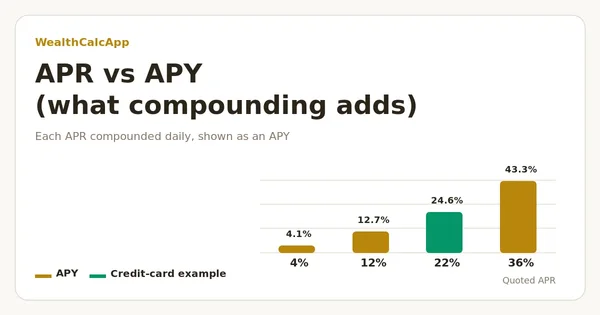
Most issuers also compound daily: each day’s interest is added to the balance, so tomorrow’s interest is charged on today’s interest too. That is why a 22% APR works out at about 24.6% a year if you never pay the balance down. We explain the difference between the quoted rate and the effective rate in APR vs APY.
A worked example: one billing cycle, step by step
Say your card has a 22% APR and a 30-day billing cycle. You start the cycle owing $2,000 that you didn’t pay off last month, buy a $900 laptop on day 11 and pay $500 on day 21.
| Days | Balance | Days at that balance | Balance × days |
|---|---|---|---|
| 1–10 | $2,000 | 10 | $20,000 |
| 11–20 (after the $900 purchase) | $2,900 | 10 | $29,000 |
| 21–30 (after the $500 payment) | $2,400 | 10 | $24,000 |
| Total | 30 | $73,000 |
Daily periodic rate = 22% ÷ 365 = 0.060274%
Interest = $2,433.33 × 0.060274% × 30 = $44.00 (about $44.37 with daily compounding)
Two things stand out. First, the timing of payments matters, not just their size. Had you paid the same $500 on day 1 instead of day 21, the average daily balance would have been $2,100 and the interest $37.97, saving $6.03 without paying a cent more. Second, because you were already carrying a balance, the new laptop started costing interest on the day you bought it.
Your statement shows the result under a heading such as “Interest charge calculation”: the APR, the balance subject to interest and the interest for each type of balance.
The grace period: how to pay no interest at all
The grace period is the gap between the end of a billing cycle and the payment due date. If you pay the full statement balance by the due date, most cards charge no interest at all on purchases. Issuers aren’t required to offer one, but most do, and the CARD Act says your bill must arrive at least 21 days before the due date.
- Pay the statement balance, not the minimum or the “current balance”. The statement balance is what you owed at the end of the cycle; paying that in full keeps the grace period. Purchases made since then will appear on the next statement.
- Carrying any balance usually ends the grace period. From then on, new purchases are charged interest from the day you make them, as the laptop was in the example above.
- Getting it back can take a month or two. Many cards restore the grace period only after you pay the statement balance in full for one or two cycles in a row. The cardholder agreement says which.
- Expect trailing interest. When you finally clear a carried balance, the next statement can still show a small interest charge for the days between your last statement and your payment. On $1,000 at 22%, a month of that is about $18. Pay it too, or it starts the cycle again.
Why the minimum payment keeps you in debt for decades
Card issuers set the minimum payment with a formula, usually either 1% of the balance plus that month’s interest and fees, or a flat 2–3% of the balance, with a floor of around $25–$40. Either way, the minimum falls as the balance falls, so you never build up speed. Here is a $5,000 balance at 22%:
| How you pay | Time to pay off | Total interest |
|---|---|---|
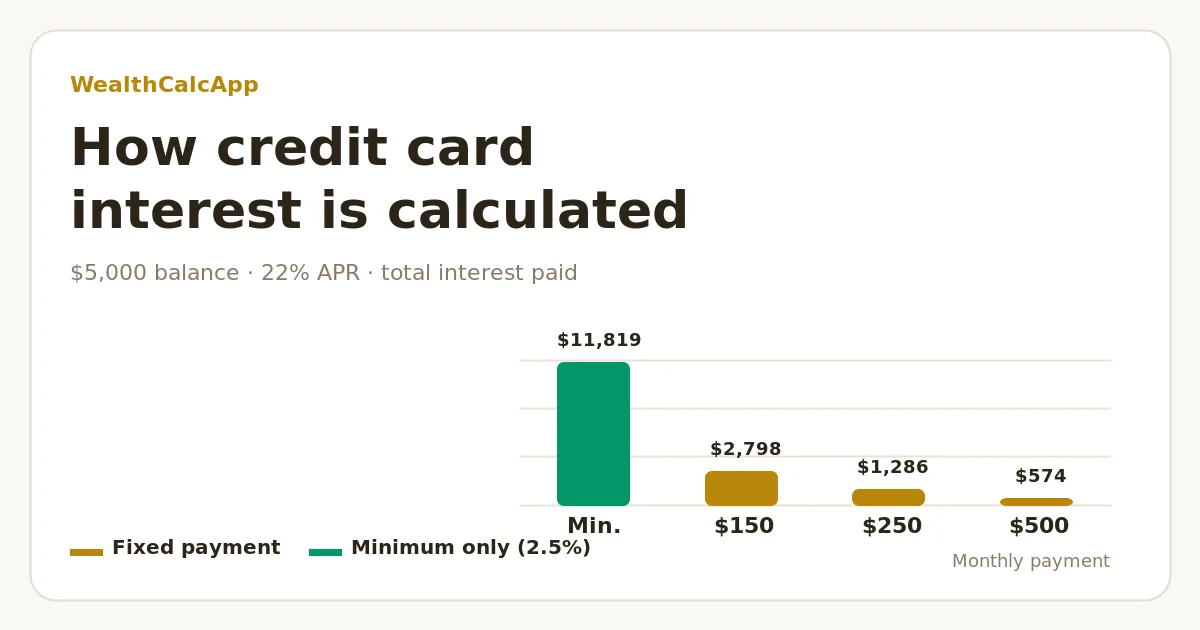
| Minimum only: 2.5% of balance, at least $25 | 26 years 2 months | $11,819 |
| Minimum only: 1% + interest, at least $25 | 19 years 2 months | $8,100 |
| Fixed $150 a month | 4 years 4 months | $2,798 |
| Fixed $250 a month | 2 years 2 months | $1,286 |
| Fixed $500 a month | 1 year | $574 |
With 2.5% minimums, the first payment is $125, of which $91.67 is interest. You end up paying more than twice the original balance in interest alone. The fix doesn’t need much more money: just keep paying the first minimum. On the 1%-plus-interest formula, the first minimum is $141.67; paying that every month instead of letting it shrink clears the card in under five years for $3,121 of interest.
Your statement already does some of this maths for you. US statements must include a minimum payment warning showing how long payoff takes and what it costs if you pay only the minimum, plus the monthly payment that would clear the balance in three years.
You can run this example in the credit card payoff calculator and change the balance, APR or payment to see your own payoff date and total interest.
Cash advances, balance transfers and penalty APRs
A single card can carry several balances, each with its own APR: purchases, cash advances, a balance transfer and sometimes a promotional rate. The issuer works out the interest on each one separately with the same daily method, then adds them up.
- Cash advances cost the most. Expect a fee of 3–5% (often at least $10), an APR several points above the purchase rate and no grace period, so interest starts on the day you take the cash. A $500 advance at 29.99% for 30 days costs $12.32 in interest plus a $25 fee: $37.32 for one month.
- Balance transfers with a 0% introductory APR can save a lot, but they are not free. Move $5,000 with a 4% fee and you owe $5,200; 18 payments of $288.89 clear it before the offer ends. Paying the same $288.89 a month at 22% would take 22 months and cost $1,070 in interest. The catch: purchases on that card may lose their grace period while the transferred balance is unpaid.
- Deferred interest is a different deal from 0% APR, and often found on store cards. “No interest if paid in full in 12 months” means that if any balance remains at the end, you are charged all the interest back to the original purchase date.
- Penalty APRs, often close to 30%, can apply to new purchases after a late payment and to your existing balance once a payment is 60 days late. Issuers must review the rate after six months of on-time payments.
When you pay more than the minimum, US law requires the issuer to apply the extra to the balance with the highest APR first. The minimum itself can go to the cheapest balance, which is one more reason to pay well above it. If you have several cards, our guide to debt payoff strategies compares paying the highest rate first with paying the smallest balance first.
Check your statement in a spreadsheet
Excel, Google Sheets and LibreOffice can do every part of this. Replace the variables with your own figures:
Interest for a cycle: =[AVG DAILY BALANCE]*[APR]/365*[DAYS] → =2433.33*22%/365*30 = 44.00
With daily compounding: =[BALANCE]*((1+[APR]/365)^[DAYS]-1)
Months to pay off: =NPER([APR]/12, -[PAYMENT], [BALANCE]) → =NPER(22%/12,-250,5000) = 25.1
Payment to clear it in N months: =PMT([APR]/12, [N], -[BALANCE]) → =PMT(22%/12,24,-5000) = 259.39
To check a statement properly, make one row per day of the billing cycle with three columns: transactions, closing balance and that day’s interest. Add up the balances, divide by the number of days and compare the result with the “balance subject to interest rate” on your statement. If your figure is a little off, the usual reasons are a 360-day year, fees included in the balance, or a cycle of 29 or 31 days rather than 30.
Five ways to pay less credit card interest
- Pay in full and keep the grace period. If you can, this is the whole answer: no balance carried, no interest on purchases.
- Pay early, and more than once a month. Interest follows the average daily balance, so a payment on payday rather than on the due date lowers it. In the example above, the same $500 paid 20 days earlier saved $6 in a single month.
- Choose a payoff date and fix the payment. Use =PMT or the payoff calculator to find the payment that clears the card in, say, 24 months ($259 a month on $5,000 at 22%) and stop following the minimum.
- Move the debt somewhere cheaper. A balance transfer or a personal loan at 12% over 24 months costs $235 a month and $649 in interest on $5,000, against $1,225 on the card over the same period. Compare the full cost, fees included; our guide to the best personal loans shows what to check.
- Ask for a lower APR. If you have paid on time for a year or two, call the issuer and ask. It doesn’t always work, but it costs nothing, and a better credit score makes it more likely.
If the balance is big enough that none of these feels possible, start with the plan in how to pay off debt fast, then use the debt payoff calculator to set a realistic date.
Limits worth knowing
- Your card agreement is the final word. Issuers can use a 360- or 365-day year, include or exclude new purchases and fees in the average daily balance, and compound daily or not. The method described here is the most common, not the only one.
- Our calculator simplifies. It applies the APR ÷ 12 to the balance once a month. With daily compounding, real interest runs about 1% higher (around 44 cents more on a $44 charge), so treat its results as close estimates, not your statement.
- Most card APRs are variable. They are usually set as the prime rate plus a margin, so they move when the Federal Reserve changes rates. The examples assume the APR stays at 22% throughout.
- Fees are not interest. Annual, late and foreign transaction fees come on top of the APR.
- Minimum payment formulas vary. The two in the table are common examples; your statement shows the one your issuer uses.
References
- Consumer Financial Protection Bureau — What is a grace period for a credit card?
- Federal Reserve — G.19 Consumer Credit (interest rates on credit card plans)
- Wikipedia — Credit card interest
Frequently asked questions
Passionate about finance and investing, with more than 6 years of hands-on experience in the crypto world. He shares analysis and financial education on his YouTube channel, Cripto Adicto.
Watch on YouTube →Keep reading
Work out your own payoff date
Enter your balance, APR and monthly payment to see how long the card takes to clear, the total interest, and how that compares with paying only the minimum.
Open the Credit Card Payoff Calculator →