
How to Calculate Your Debt-to-Income Ratio: The Formula, What Counts and What Lenders Accept


Your debt-to-income ratio, or DTI, is the share of your monthly income that is already promised to lenders. It is the number a mortgage underwriter looks at straight after your credit report, and it decides more applications than most people realise: a good credit score will not save a loan whose payments take 55% of your pay. The sum itself takes a minute. The hard part is knowing which payments count, which income the lender will accept and which limit applies to your loan. This guide covers all three, with worked examples and the quickest ways to bring the ratio down before you apply.
The debt-to-income formula
The Consumer Financial Protection Bureau defines DTI as all your monthly debt payments divided by your gross monthly income, meaning what you earn before tax and other deductions:
Front-end ratio = [MONTHLY HOUSING PAYMENT] ÷ [GROSS MONTHLY INCOME] × 100
Back-end ratio = ([HOUSING PAYMENT] + [ALL OTHER DEBT PAYMENTS]) ÷ [GROSS MONTHLY INCOME] × 100
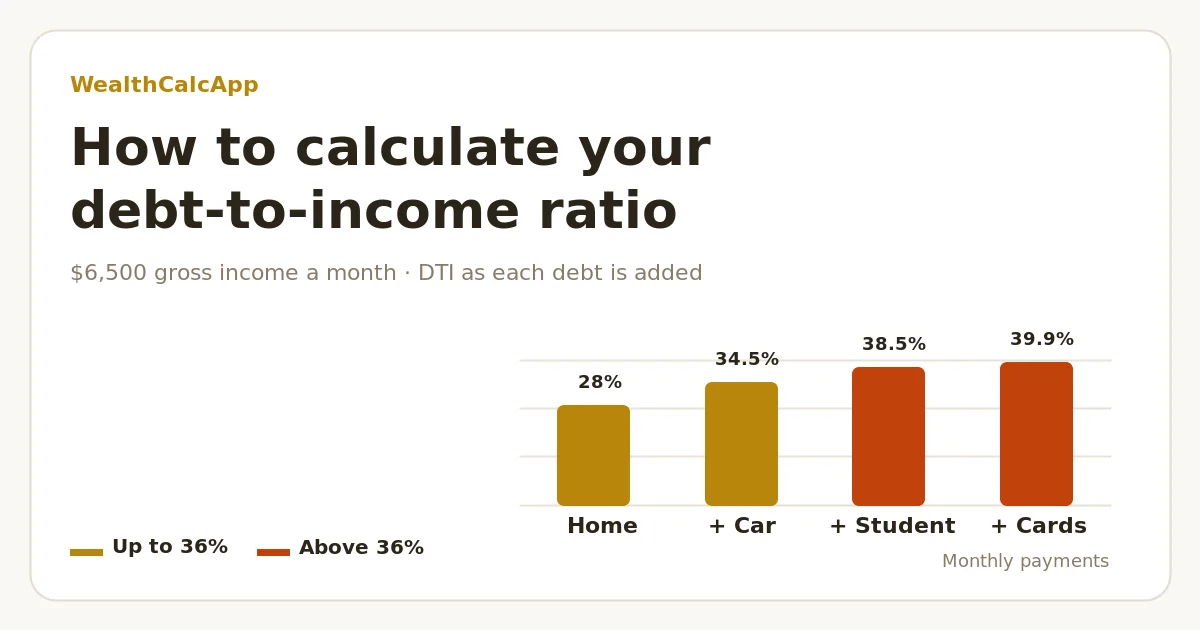
Take Alex, who earns $78,000 a year, or $6,500 a month before tax. The mortgage Alex wants would cost $1,820 a month including property tax and insurance. Alex also pays $420 on a car loan, $260 on student loans and $95 in credit card minimums.
- Add up the monthly payments: $1,820 + $420 + $260 + $95 = $2,595.
- Work out gross monthly income: $78,000 ÷ 12 = $6,500.
- Divide and multiply by 100: $2,595 ÷ $6,500 = 0.399, a back-end DTI of 39.9%.
- For the front-end ratio, use the housing payment alone: $1,820 ÷ $6,500 = 28.0%.
When people, lenders included, say “your DTI” without qualifying it, they nearly always mean the back-end figure, because it includes everything. The front-end ratio matters mainly for mortgages, and it is the first half of the 28/36 rule explained in our guide to how much house you can afford.
Which payments count as debt, and which don’t
DTI only counts payments a lender can see on your credit report or in your court and loan documents. Your living costs are left out entirely, which is exactly why a “good” DTI can still sit alongside a tight budget.
| Counted | Not counted |
|---|---|
| Mortgage or new housing payment: principal, interest, property tax, insurance, HOA fees, mortgage insurance | Utilities, phone, internet and streaming subscriptions |
| Car loans and leases | Groceries, petrol and commuting |
| Student loans, including deferred ones (see below) | Health, car and life insurance premiums |
| Credit card minimum payments (not the full balance) | Childcare and school fees |
| Personal loans, store finance and other instalment loans | Income tax and payroll deductions |
| Child support and alimony you pay | Retirement contributions |
A few rules from the Fannie Mae Selling Guide, which most US lenders follow for conventional loans, catch people out:
- Card balances with no minimum shown are counted at 5% of the balance. A $3,200 balance becomes a $160 monthly debt, even if you clear it in full every month.
- Deferred student loans still count. If no payment is due, the lender may use 1% of the balance: $240 a month on $24,000. A $0 payment is only accepted on a documented income-driven plan.
- Short instalment loans with ten or fewer payments left can usually be left out, unless the payment is large enough to strain your budget.
- Co-signed debts count against you too, unless you can show twelve months of bank statements proving the other person makes the payments.
- Your current rent drops out when you apply for a mortgage, because the new housing payment replaces it. For a car or personal loan, many lenders do include your rent.
Which income counts: gross, and only what you can document
Lenders use gross income, before tax, 401(k) contributions and health premiums, but only income they consider stable and likely to continue. In practice that means income you can prove with pay slips, W-2s and tax returns:
- Salary: annual pay ÷ 12. Hourly pay: rate × usual hours × 52 ÷ 12, so $32 an hour at 40 hours is $5,546.67 a month.
- Overtime, bonuses and commission: usually averaged over the last two years, and only if they look set to continue. A bonus you received once does not count.
- Self-employed and 1099 income: net profit after business expenses, typically averaged over two years of tax returns. Revenue of $110,000 with $40,000 of expenses counts as $70,000; if the year before was $62,000, the lender may use the average, $5,500 a month. Every expense you claim to cut your tax bill also cuts your qualifying income.
- Rental income: lenders typically count only 75% of the gross rent to allow for vacancies and repairs, so $1,800 a month of rent becomes $1,350.
- Non-taxable income, such as some disability benefits, can often be “grossed up”, usually by up to 25%, because it is worth more than the same amount of taxable pay.
One consequence surprises people: if you are paid partly in cash, or your side income is too new to appear on a tax return, it may not count at all.
What is a good debt-to-income ratio?
No single number is right for everyone, but lenders and counsellors use broadly similar bands for the back-end ratio:
| Back-end DTI | What it usually means |
|---|---|
| Up to 35–36% | Comfortable. Most loans available on standard terms, with room for surprises. |
| 36–43% | Manageable. Most mortgage programmes still approve you, but you have less slack. |
| 43–50% | Stretched. Possible for some loans with a strong credit score, savings or a larger down payment. |
| Above 50% | Few mortgage lenders will approve you, and a budget shock becomes hard to absorb. |
The ceiling depends on the type of loan and on whether software or a person underwrites it:
| Loan type | Typical DTI limits |
|---|---|
| Conventional (Fannie Mae, automated) | Up to 50% through Desktop Underwriter |
| Conventional (manual underwriting) | 36%, or up to 45% with the required credit score and reserves |
| FHA | 31% front-end and 43% back-end as a baseline; higher with compensating factors or an automated approval |
| VA | 41% guideline, with residual income weighing as much as the ratio |
| USDA | 29% front-end and 41% back-end as standard |
You may still read that 43% is a legal maximum. It used to be the cap for a “qualified mortgage”, but the CFPB replaced it with a pricing test, and lenders have had to comply since October 2022. Lenders must still weigh your DTI or residual income; they are simply no longer tied to 43%. Bear in mind, too, that many lenders add their own limits, or “overlays”, on top of these programme rules.
Three worked examples, and how to work backwards
Here is the same calculation for three households applying for a mortgage. All figures are monthly, and the housing payment includes tax and insurance:
| Household | Gross income | Housing | Other debts | Front-end | Back-end |
|---|---|---|---|---|---|
| Couple, no car loan | $9,000 | $2,250 | $350 | 25.0% | 28.9% |
| Alex | $6,500 | $1,820 | $775 | 28.0% | 39.9% |
| Sam | $5,000 | $1,600 | $1,100 | 32.0% | 54.0% |
The couple is well inside every limit. Alex can borrow under most programmes, but above the 36% comfort level. Sam has a problem: the house alone is affordable, yet the other debts push the total past 50%, so the fix is to clear debt before applying rather than to hunt for a cheaper house.
Turning the formula around shows the biggest housing payment a limit allows:
Alex at 36%: $6,500 × 0.36 − $775 = $1,565
Alex at 43%: $6,500 × 0.43 − $775 = $2,020
Alex at 50%: $6,500 × 0.50 − $775 = $2,475
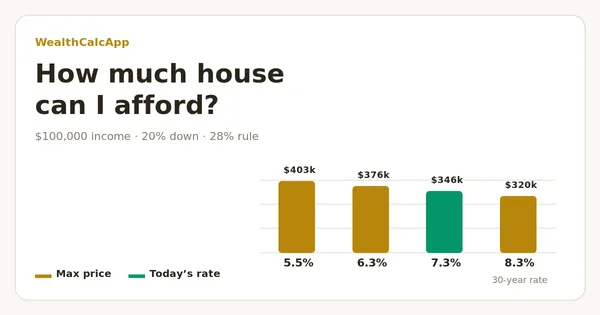
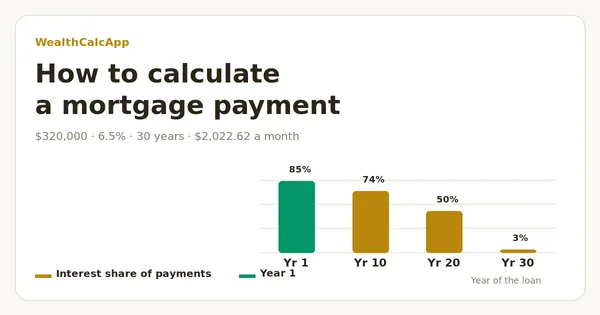
That payment still has to be turned into a home price, which depends on the rate, the term and the down payment. You can open Alex’s numbers in the affordability calculator and change the limit, and our article on how to calculate a mortgage payment shows the formula behind it.
How to lower your DTI before you apply
There are only two levers: smaller monthly payments or more documented income. Some moves work far faster than others:
- Pay off whole debts, not slices of them. Paying extra on an instalment loan cuts the balance, but the required payment stays the same, so your DTI does not move until the loan is gone. Card minimums do fall as the balance falls.
- Rank debts by the payment removed per $1,000. Clearing Alex’s car loan, with 14 payments and about $5,630 left, removes $420 a month, or $75 per $1,000, and cuts DTI from 39.9% to 33.5%. Clearing $3,200 of cards removes $95, about $30 per $1,000. Paying $1,000 off the $24,000 student loan removes nothing at all.
- Do not open new credit in the months before applying. A new car loan or store card adds a payment, and the lender will see it.
- Document every income stream. Two years of steady overtime, a second job or a co-borrower’s income can all count; $1,000 more a month would take Alex to 34.6%.
- Change the loan rather than the borrower. A larger down payment, a cheaper home or a longer term lowers the housing payment and therefore both ratios.
Choosing which debt to tackle first is the same question we answer in snowball vs avalanche; for DTI purposes, the payment-per-dollar ranking above usually wins. The debt payoff calculator shows how long each balance takes to clear, and if card interest is the problem, see how credit card interest is calculated.
DTI and your credit score
Your DTI is not part of your credit score. The credit bureaus do not know your income, so FICO and VantageScore cannot calculate it. What they measure instead is credit utilisation: card balances divided by card limits. The two often move together, because paying down cards improves both, but they are different numbers and lenders check them separately.
This works both ways. A high earner with a 780 score can be declined on DTI alone, while someone with a modest score and almost no debt can have an excellent ratio. Our credit score guide covers the score side; your DTI is something you can only fix with payments and income.
Limits worth knowing
- Gross income flatters the picture. A 36% DTI can be close to half of your take-home pay once income tax, Social Security and Medicare are gone, and more in a high-tax state.
- It ignores what you actually spend. Childcare, insurance, commuting and a growing family are invisible to DTI. Check the payment against a real budget; our budgeting guide is a good place to start.
- It is a snapshot. Lenders measure DTI at application. A variable-rate loan, a job change or an interest-only period ending can change it a year later.
- Rules differ by lender and change over time. The limits above are programme maximums. A lender can be stricter, and loan officers sometimes calculate income differently from your own figures.
- Our calculator simplifies. It applies the limit you enter to the income and debts you type in. It cannot apply the 5% or 1% rules or decide which income a lender will accept, so treat the result as an estimate, not a pre-approval.
References
- Consumer Financial Protection Bureau — What is a debt-to-income ratio?
- Fannie Mae Selling Guide — B3-6-02, Debt-to-Income Ratios
- Wikipedia — Debt-to-income ratio
Frequently asked questions
Passionate about finance and investing, with more than 6 years of hands-on experience in the crypto world. He shares analysis and financial education on his YouTube channel, Cripto Adicto.
Watch on YouTube →Keep reading

Check your numbers before the lender does
Enter your gross income, your other monthly debts and a DTI limit to see the largest housing payment you qualify for and the home price it buys at the rate you choose.
Open the Affordability Calculator →