How to Calculate Compound Interest: The Formula, Worked Examples and the Catches


Compound interest is interest paid on interest. Once a deposit earns interest, that interest is added to the balance and starts earning too, so the balance grows a little faster every year. The idea is simple; the arithmetic is where people go wrong: mixing annual rates with monthly periods, compounding a rate that already includes compounding, or forgetting that inflation and tax take their share. This guide works through the formula, the most common cases, the spreadsheet functions and the reverse calculations, with every figure checked against our compound interest calculator.
The compound interest formula, piece by piece
For a single deposit left to grow, the balance at the end is:
Interest earned = A − P
P = [STARTING AMOUNT] r = [ANNUAL RATE AS A DECIMAL] n = [COMPOUNDING PERIODS PER YEAR] t = [YEARS]
Take $10,000 at 5% a year, compounded monthly, for 10 years. The rate per period is 0.05 ÷ 12 = 0.0041667, and there are 12 × 10 = 120 periods. Then 1.0041667 raised to the power of 120 is 1.64701, so A = 10,000 × 1.64701 = $16,470.09, of which $6,470.09 is interest.
Done by hand or on a phone calculator, the steps are always the same:
- Turn the rate into a decimal: 5% becomes 0.05.
- Divide it by the number of compounding periods a year: 0.05 ÷ 12 = 0.0041667.
- Multiply the years by the same number to get the total periods: 10 × 12 = 120.
- Add 1 to the periodic rate and raise it to the power of the periods: 1.0041667^120 = 1.64701.
- Multiply by the starting amount, then subtract it if you only want the interest.
Compare that with simple interest, which is only ever paid on the original deposit: I = P × r × t = $10,000 × 0.05 × 10 = $5,000. The extra $1,470 is interest earned on earlier interest. The gap starts tiny and keeps widening, because each year’s interest is worked out on a bigger balance. Compounded once a year, the same deposit earns $500 in year one, $525 in year two and $551.25 in year three.
Annual, monthly or daily: how often interest compounds
The more often interest is added to the balance, the sooner it starts earning. Here is the same $10,000 at 5% for 10 years:
| Compounding | n | Balance after 10 years | Effective annual rate |
|---|---|---|---|
| Annually | 1 | $16,288.95 | 5.000% |
| Quarterly | 4 | $16,436.19 | 5.095% |
| Monthly | 12 | $16,470.09 | 5.116% |
| Daily | 365 | $16,486.65 | 5.127% |
| Continuously | — | $16,487.21 | 5.127% |
Frequency helps, but less than most people expect. Monthly instead of annual compounding is worth $181 over ten years here; going from daily to continuous adds 56 cents. The rate matters far more: 5.5% compounded just once a year grows to $17,081, beating 5% compounded daily.
Continuous compounding: A = P × e^(r × t) → 10,000 × e^0.5 = 16,487.21
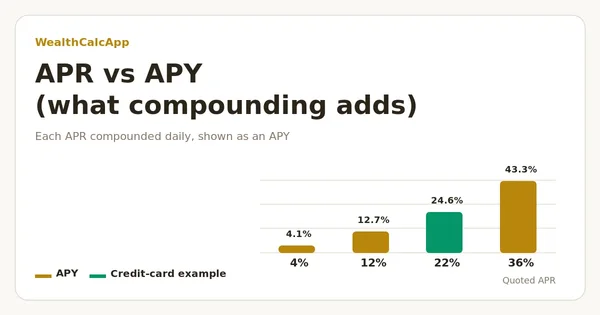
That effective rate is what US banks publish as the APY. If an account quotes an APY, the compounding is already built in, so do not divide it by 12 and compound it again: use A = P × (1 + APY)^t. Our guide to APR vs APY explains when you are looking at which.
Adding monthly deposits: the formula most calculators use
Most people do not invest one lump sum and walk away; they add money every month. Each deposit compounds for a different length of time, so you add a second term, the future value of a series of payments:
i = [ANNUAL RATE] ÷ 12 N = [YEARS] × 12 PMT = [MONTHLY DEPOSIT]
Deposits at the start of each month: multiply the PMT term by (1 + i)
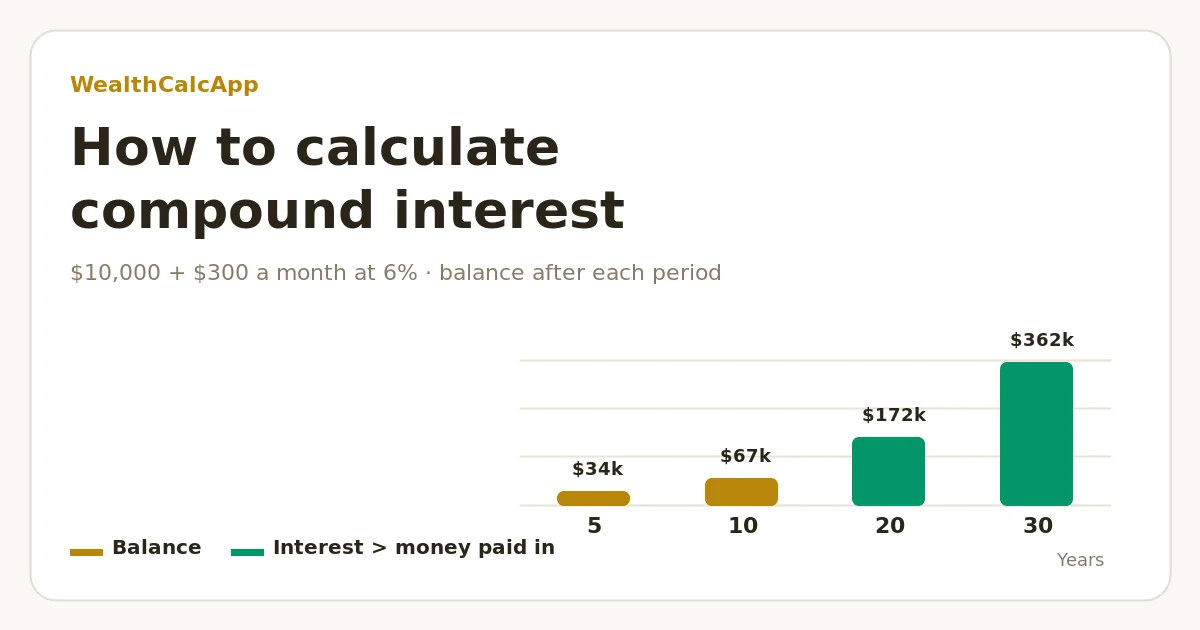
Example: $10,000 now plus $300 a month at 6% for 20 years. The lump sum grows to 10,000 × 1.005^240 = $33,102.04. The deposits grow to 300 × (1.005^240 − 1) ÷ 0.005 = $138,612.27. Together that is $171,714.31: $82,000 paid in and $89,714.31 of interest. Paying at the start of each month instead of the end adds about $693.
| Years | Paid in | Balance | Of which interest |
|---|---|---|---|
| 5 | $28,000 | $34,419.51 | $6,419.51 |
| 10 | $46,000 | $67,357.77 | $21,357.77 |
| 20 | $82,000 | $171,714.31 | $89,714.31 |
| 30 | $118,000 | $361,580.26 | $243,580.26 |
Look at the last column. After 5 years interest is less than a quarter of the balance; after 30 it is two-thirds. Raising the deposit by 3% a year, roughly in line with pay, takes the 20-year figure to $208,813. You can open this example in the calculator and change any of the inputs.
The same maths explains why starting early matters so much. $200 a month at 6% from age 25 to 65 grows to about $398,000. Start at 35 and you end up with about $201,000: half as much, although you paid in only $24,000 less. Our article on the power of compound interest looks at that effect in more depth.
Compound interest in Excel or Google Sheets
Spreadsheets have these formulas built in, and the functions work the same way in Excel and Google Sheets. Money you pay in is entered as a negative number, which is why the signs look odd:
With deposits: =FV([RATE]/12, [YEARS]*12, -[PMT], -[P]) → =FV(6%/12, 240, -300, -10000) = 171,714.31
Deposits at start: =FV(6%/12, 240, -300, -10000, 1) = 172,407.37
Effective rate: =EFFECT([RATE], [N]) → =EFFECT(5%, 12) = 5.116%
To build a year-by-year table, put the years in column A (0, 1, 2…), the starting amount in B2 and this in B3, then fill it down: =FV(6%/12, 12, -300, -B2). Each row compounds the previous balance for twelve months and adds twelve deposits, so row 22 shows the 20-year balance of $171,714.31.
Working backwards: how long, what rate, how much to save
Rearrange the formula and it answers the questions people actually have when they plan:
Rate needed: r = (A ÷ P)^(1 ÷ t) − 1 → $10,000 to $20,000 in 10 years: 7.18% a year
Monthly deposit needed: PMT = (FV − P × (1 + i)^N) × i ÷ ((1 + i)^N − 1) → $100,000 in 15 years from $5,000 at 6%: $301.66
Spreadsheet: =NPER(5%/12, 0, -10000, 20000)/12 =RATE(10, 0, -10000, 20000) =PMT(6%/12, 180, -5000, 100000)
PMT returns −301.66; the minus sign just means money going in. For a quick check in your head, use the rule of 72: 72 ÷ 5 = 14.4 years to double, close to the exact 14.2 years with annual compounding and 13.9 with monthly. The “rate needed” line is the same calculation as a compound annual growth rate, which our guide to CAGR covers in detail.
A shorter goal works the same way. To have $50,000 for a house deposit in five years in an account paying 4%, you need about $754 a month; without any interest it would be $833. Over short periods compounding helps, but most of the money still comes from what you save.
Inflation, tax and fees: the growth you actually keep
The formula gives you a nominal balance in future dollars. Three things shrink what that balance is really worth:
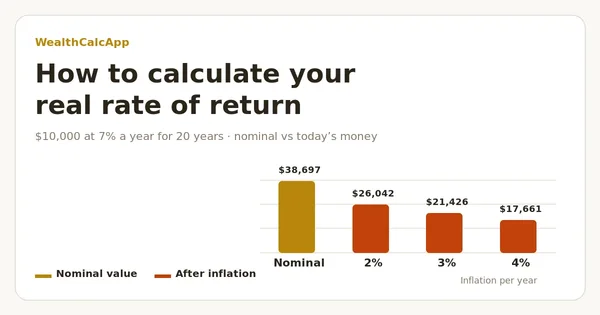
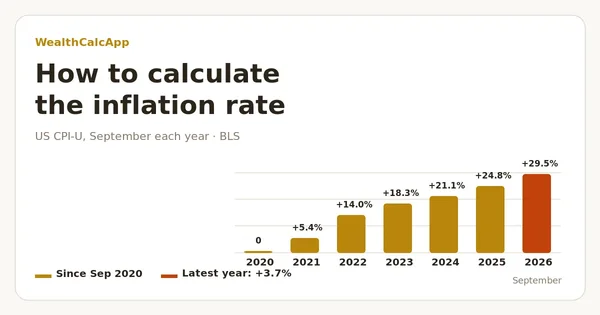
- Inflation. The real rate is (1 + nominal rate) ÷ (1 + inflation) − 1, so 6% with 2.5% inflation is 3.41%, not 3.5%. The $361,580 from the 30-year example is worth about $172,000 in today’s money. Enter an inflation rate in the calculator and it shows both figures.
- Tax. Interest in an ordinary savings account is taxed every year at your income tax rate, so in practice you compound the after-tax rate. $10,000 at 6% for 30 years grows to $57,435 untaxed. Taxed at 24% each year, the effective rate is 4.56% and you end with $38,104. In a tax-deferred account taxed at 24% only on withdrawal, you keep $46,051; in a Roth account, the full $57,435. Our guide to tax-advantaged accounts explains the options.
- Fees. A 1% annual fee comes straight off the rate, every year. $10,000 plus $300 a month for 30 years reaches $361,580 at 6% but $294,355 at 5%. That single point costs $67,225, more than half of the $118,000 you paid in. See how investment fees compound.
When compounding works against you: debt
The same maths runs in reverse on money you owe. US credit cards usually compound daily, so a 24% APR is an effective 27.1% a year. Leave a $5,000 balance untouched for three years and, before fees, it grows to $10,270. In practice you must make minimum payments, but the example shows how fast an unpaid balance builds. Our guide to how credit card interest is calculated walks through a real statement.
Most mortgages, car loans and personal loans charge interest on the outstanding balance each month, and your payment covers it, so the interest does not compound as long as you pay on time. Missed payments, or unpaid interest added to a student loan when a deferment ends, are what turn ordinary interest into compound interest. The practical conclusion is simple: paying off a 24% card is a guaranteed return of more than 24%, better than almost any investment.
Limits worth knowing
- Investments do not pay a fixed rate. A savings account or a CD does. For a stock fund, 6% or 7% is an assumption about an average, and the real returns arrive in an uneven order.
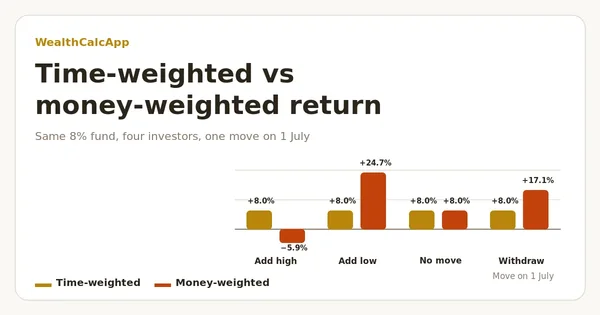
- Average return is not compound return. A gain of 50% followed by a loss of 50% averages 0%, but leaves you with 75% of your money: −13.4% a year. Returns of +20%, −10%, +20%, −10% average 5% but compound at 3.9%. For planning, use the compound (geometric) rate, not the simple average.
- Banks round and count days. Interest may be calculated daily on an actual/365 basis and credited monthly, so a statement can differ from the formula by a few cents.
- Check which rate you have. Compounding an APY again, or treating an APR as the effective rate, are the two most common errors.
- Our calculator simplifies. It assumes the same rate every month and ignores tax and fees unless you lower the rate yourself, so treat its results as scenarios, not forecasts.
References
- Investor.gov (SEC) — Compound interest calculator
- Microsoft Support — FV function
- Wikipedia — Compound interest
Frequently asked questions
Passionate about finance and investing, with more than 6 years of hands-on experience in the crypto world. He shares analysis and financial education on his YouTube channel, Cripto Adicto.
Watch on YouTube →Keep reading


See your money compound
Enter a starting amount, a monthly deposit, the rate and the compounding frequency to see the balance year by year, how much of it is interest and what it is worth after inflation.
Open the Compound Interest Calculator →