
Is Bitcoin Mining Profitable? How to Run the Numbers Before You Buy a Miner


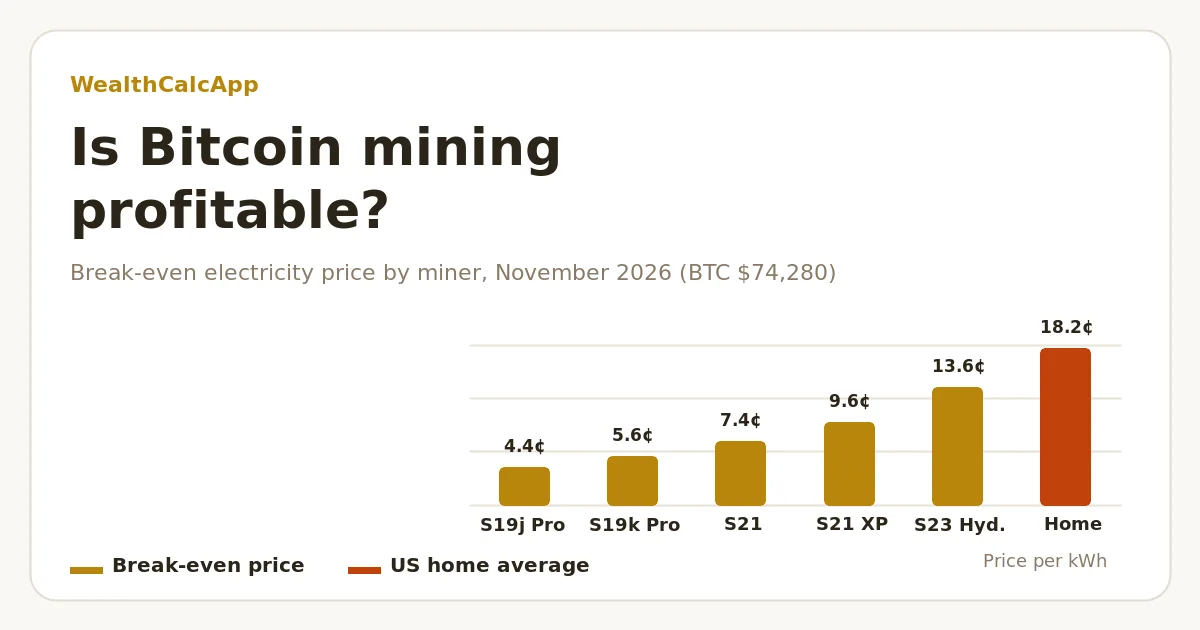
Mining calculators make Bitcoin mining look like a vending machine: plug in a box, collect a few dollars a day. The real answer depends on one number most buyers never check, the price you pay per kilowatt-hour, and on two you cannot control, the bitcoin price and the network’s total hashrate. In November 2026 a new Antminer S21 XP earns about $8.39 a day and burns 87.5 kWh doing it. At an average US home rate of around 18 cents, that is a loss of more than $7 a day. This guide shows how to calculate mining profitability yourself, with the formula, current network figures, a worked example, the costs calculators leave out and the April 2028 halving that will cut revenue in half.
The short answer: your share of the network, minus electricity
Every ten minutes or so the network pays out one block reward: a fixed subsidy of 3.125 BTC plus the transaction fees in that block. Your miner earns a share of those rewards equal to its share of the total hashrate. Everything else is electricity:
Daily profit = Daily BTC × [BTC PRICE] − [POWER IN kW] × 24 × [PRICE PER kWh]
Break-even price per kWh = Daily revenue ÷ ([POWER IN kW] × 24)
The 144 is the number of blocks the network targets per day. Network hashrate is not measured directly; it is estimated from the difficulty, which resets every 2,016 blocks so that blocks keep arriving every ten minutes on average. When more machines join, difficulty rises and every existing machine earns less, even if nothing in your setup changes.
Miners compress the first line into one figure, hashprice: the revenue per unit of hashrate per day. It moves with the bitcoin price, the difficulty and fees, and it lets you compare machines quickly. Multiply hashprice by your hashrate and you have gross revenue before electricity.
Step 1: what a terahash earns in November 2026
These are the inputs on 9 November 2026, taken from the public blockchain data at mempool.space:
| Input | Value | Where it comes from |
|---|---|---|
| BTC price | $74,280 | Exchange average; down from about $88,000 in January |
| Difficulty | 148.4 trillion | Set at the 29 October retarget |
| Implied network hashrate | about 1,062 EH/s | Difficulty × 232 ÷ 600 seconds |
| Block subsidy | 3.125 BTC | Halves at block 1,050,000 |
| Average fees | 0.022 BTC per block | Last 1,008 blocks: 0.7% of miner revenue |
| Hashprice | $31.70 per PH/s per day | Revenue per petahash (1,000 TH/s), before pool fees |
So each terahash per second of hashrate earns about 3.2 cents a day before the pool takes its cut, typically 2% on a pay-per-share pool. Fees barely matter right now: at 0.022 BTC a block they add less than 1% to revenue, so do not count on a fee spike to rescue the numbers.
Step 2: the electricity price decides almost everything
Since revenue per terahash is the same for everyone, the only thing that separates machines is how many joules they burn per terahash (J/TH). That gives a shortcut for the electricity price at which a miner stops making money:
| Machine | Efficiency | Break-even today | After the 2028 halving |
|---|---|---|---|
| Antminer S23 Hydro | 9.5 J/TH | 13.6¢/kWh | 6.9¢/kWh |
| Antminer S23 (air) | 11 J/TH | 11.8¢/kWh | 5.9¢/kWh |
| Antminer S21 XP | 13.5 J/TH | 9.6¢/kWh | 4.8¢/kWh |
| Antminer S21 | 17.5 J/TH | 7.4¢/kWh | 3.7¢/kWh |
| Antminer S19k Pro | 23 J/TH | 5.6¢/kWh | 2.8¢/kWh |
| Antminer S19j Pro | 29.5 J/TH | 4.4¢/kWh | 2.2¢/kWh |
Compare that with what you pay. The EIA expects the average US residential rate to be about 18.2 cents per kWh in 2026, roughly double the break-even price of even the latest air-cooled machine. That is why most hashrate sits in industrial sites paying 4 to 6 cents, and why hosting providers quote all-in rates of roughly 7 to 9 cents. Use your marginal rate, including delivery charges and taxes, not the energy-only figure on the first line of your bill.
A worked example: one Antminer S21 XP
The S21 XP is the most common current-generation air-cooled miner: 270 TH/s at 3,645 W. New units were quoted between about $2,900 and $4,250 in autumn 2026; the example uses $3,500. With the November figures and a 2% pool fee, it mines 0.000113 BTC a day (11,291 satoshis), worth $8.39, and uses 87.5 kWh a day, or about 2,660 kWh a month: roughly three times what a typical US home uses in a whole month.
| Electricity price | Profit per day | Per month | Per year | Simple payback |
|---|---|---|---|---|
| 5¢ (industrial) | $4.01 | $122 | $1,465 | 2.4 years |
| 7¢ (cheap hosting) | $2.26 | $69 | $826 | 4.2 years |
| 10¢ | −$0.36 | −$11 | −$132 | never |
| 18.2¢ (US home average) | −$7.53 | −$229 | −$2,750 | never |
Even the good rows look better than they are, because they assume the network, the price and the block subsidy stay frozen for years. You can change any input in the mining calculator, filled in with this example at 7 cents. Try your own electricity rate first: it is the number that moves the result most.
Costs most calculators leave out
The formula covers revenue and power. A real installation adds a list of smaller costs that turn thin margins negative:
- Electrical work. The S21 XP needs 200 to 240 V. In a US home that means a dedicated 240 V circuit, usually 20 A, installed by an electrician; a standard 120 V outlet will not run it.
- Noise and heat. Air-cooled ASICs run at 75 to 76 dB, close to a vacuum cleaner that never switches off, and push out 3.6 kW of heat. Garages overheat in summer and the machine throttles or shuts down.
- Uptime. Plan for 95% to 97%, not 100%. Power cuts, pool outages, overheating and firmware updates all cost hours.
- Repairs. Fans and power supplies fail, and a dead hashboard can cut output by a third. Budget a few hundred dollars over the machine’s life.
- Hosting extras. Hosted rates often come with setup fees, deposits of one to three months, minimum terms and curtailment clauses that switch your miner off when the grid is tight.
- Falling resale value. Miners lose value fastest exactly when hashprice drops. Do not count on selling the machine for much after two or three years.
The 2028 halving and rising difficulty: why payback is shorter than it looks
At block 1,050,000, expected around April 2028, about 17 months away, the subsidy falls from 3.125 to 1.5625 BTC. Unless the price or fees rise to compensate, revenue per terahash halves overnight and the S21 XP’s break-even electricity price falls from 9.6 to 4.8 cents. Our guide to the 2028 halving covers what earlier halvings did to price and miners.
Difficulty is the second headwind. It was almost flat over the past twelve months but rose about 44% in the twelve before. The table shows the net result after three years on a $3,500 S21 XP, including the hardware, with the miner switched off whenever it loses money:
| Electricity price | Price and difficulty flat | Difficulty +2% a month | BTC +50%, difficulty +2% a month |
|---|---|---|---|
| 4¢ | −$552 | −$1,662 | +$341 |
| 5¢ | −$1,423 | −$2,115 | −$288 |
| 6¢ | −$1,876 | −$2,567 | −$743 |
| 7¢ | −$2,329 | −$3,016 | −$1,196 |
Put the other way round, at 6 cents the machine only earns back its purchase price within three years if bitcoin averages about $101,000 with flat difficulty, or $127,000 if difficulty keeps climbing 2% a month. Buying a miner today is mostly a leveraged bet on the bitcoin price.
Small miners, heat reuse and solo mining
Two kinds of home mining can still make sense, as long as you know what you are paying for.
Mining as a heater. A 3.6 kW miner is a 3.6 kW electric heater that pays you back part of the bill. If you already heat a room with electric resistance heaters at 18.2 cents, the S21 XP’s revenue cuts the net cost of that heat to about 8.6 cents per kWh. That beats a resistance heater, but a heat pump delivering three units of heat per unit of electricity costs about 6.1 cents, and the saving only exists during the heating season.
Solo mining as a lottery ticket. Small open-source miners such as the Bitaxe produce about 1.2 TH/s on 18 W. In a pool that earns about 4 cents a day while the electricity costs 8. Pointed at a solo pool, the expected value is the same, but the outcome changes: a roughly 1 in 16,800 chance per year of finding a whole block, worth about $234,000 today. It is a fair way to learn how mining works, not an income.
Cloud mining contracts that promise a fixed daily return are a different matter. Real mining income moves every day with price and difficulty; a contract that guarantees otherwise is usually paying old customers with new customers’ money.
Mining or simply buying bitcoin
The fairest test is to compare the cost of each bitcoin you mine with the market price. At 6 cents, with flat difficulty, the S21 XP mines 0.0584 BTC over three years, switching off after the halving when it stops covering its electricity. Hardware plus power costs $6,216, so each bitcoin costs you about $106,400. The same $6,216 buys 0.0837 BTC at today’s price, 43% more, without noise, wiring or repairs.
| Mine (S21 XP at 6¢) | Buy at $74,280 | |
|---|---|---|
| Money spent over three years | $6,216 | $6,216 |
| Bitcoin received | 0.0584 BTC | 0.0837 BTC |
| Cost per bitcoin | about $106,400 | $74,280 |
| Main risks | Price, difficulty, hardware, power | Price |
Mining wins only when your electricity is very cheap or free (surplus solar, stranded gas, heat you would pay for anyway) or when the price rises sharply. If what you want is exposure to bitcoin, a regular purchase plan is simpler; you can backtest one with the Bitcoin DCA calculator and compare outcomes using the ROI formula.
Limits worth knowing
- The price dominates everything. A 30% move in bitcoin, common in a few months, changes revenue by 30%. No calculator can forecast it; test a range instead.
- Difficulty is unknowable. It depends on how many new machines other people switch on, which depends on prices nobody can predict.
- Mining income is taxable when you receive it. The IRS treats mined coins as gross income at their fair market value on the day they arrive. If mining is a business, the net profit also owes self-employment tax, while electricity and depreciation become deductible. Selling the coins later is a separate capital gain from that value; see our crypto tax guide.
- Machines become obsolete. Each generation lowers the break-even price for everyone else and pushes older units out of profit.
- Pools and hosts are counterparties. Choose ones with a public track record, clear payout methods and contracts you can exit.
References
- Bitcoin Wiki — Difficulty: how it is calculated and retargeted
- IRS — Frequently asked questions on digital asset transactions
- EIA — Average price of electricity to ultimate customers by state
Frequently asked questions
Passionate about finance and investing, with more than 6 years of hands-on experience in the crypto world. He shares analysis and financial education on his YouTube channel, Cripto Adicto.
Watch on YouTube →Keep reading
Calculate your own mining profit
Enter your machine’s hashrate and power, your electricity price and today’s network figures to see daily profit, break-even electricity and payback.
Open the Mining Calculator →