
How to Calculate a Car Payment: The Formula, the Fees and the Fine Print


Most people meet their car payment for the first time across a dealer’s desk, already worked out, with a term chosen to make it look affordable. That is the wrong way round. The payment is the output of four numbers you can check yourself: the amount you finance, the interest rate, the number of months and, if there is one, a balloon or residual value at the end. This guide shows you how to build each of them, the formula that turns them into a monthly figure, a full worked example and the comparisons that actually save money: loan terms, 0% offers against cash rebates, leasing and what your budget can carry.
The car payment formula
A car loan is an ordinary amortising loan: the same payment every month, with the interest share falling and the principal share rising as the balance comes down. The monthly payment is:
P = [AMOUNT FINANCED] r = [APR] ÷ 12 n = [NUMBER OF MONTHS]
Write the rate as a decimal before you divide it: 6.5% becomes 0.065, and the monthly rate is 0.065 ÷ 12 = 0.0054167. For $25,590 over 60 months, (1 + r)^60 is 1.3828, so the payment is 25,590 × 0.0054167 × 1.3828 ÷ 0.3828 = $500.70.
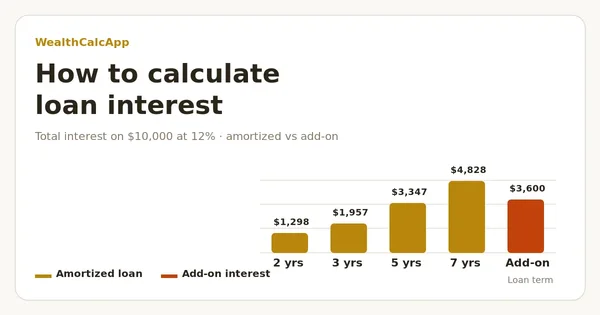
Total interest is simply everything you pay minus what you borrowed: $500.70 × 60 − $25,590 = $4,451.86. If you prefer not to do the exponent by hand, our loan calculator with this example filled in gives the payment, the total interest and the full amortization schedule, and the spreadsheet function =PMT(6.5%/12, 60, -25590) returns the same $500.70. For how the interest is split month by month, see our guide on how to calculate loan interest.
Step one: the amount you actually finance
The formula is only as good as P, and P is rarely the sticker price. Build it line by line:
− [TRADE-IN VALUE] + [NEGATIVE EQUITY] − [DOWN PAYMENT]
Take a $35,000 car with 7% sales tax, $700 of documentation, title and registration fees, an $8,000 trade-in and $4,000 down:
- Sales tax: most states tax the price minus the trade-in, so 7% × ($35,000 − $8,000) = $1,890. A few states, California among them, tax the full price, which here would be $2,450.
- Price plus tax and fees: $35,000 + $1,890 + $700 = $37,590.
- Less the trade-in and the down payment: $37,590 − $8,000 − $4,000 = $25,590.
Two lines deserve suspicion. Negative equity is what you still owe on the old car above its trade-in value; if you owe $10,000 on a car worth $8,000, the missing $2,000 is quietly added to the new loan, raising the payment by about $39 a month and the interest by about $350. Add-ons such as extended warranties, paint protection or GAP insurance are often rolled in the same way, and you pay interest on them for the whole term. Ask for an itemised buyer’s order and run the formula on it before you sign.
How the loan term changes the payment
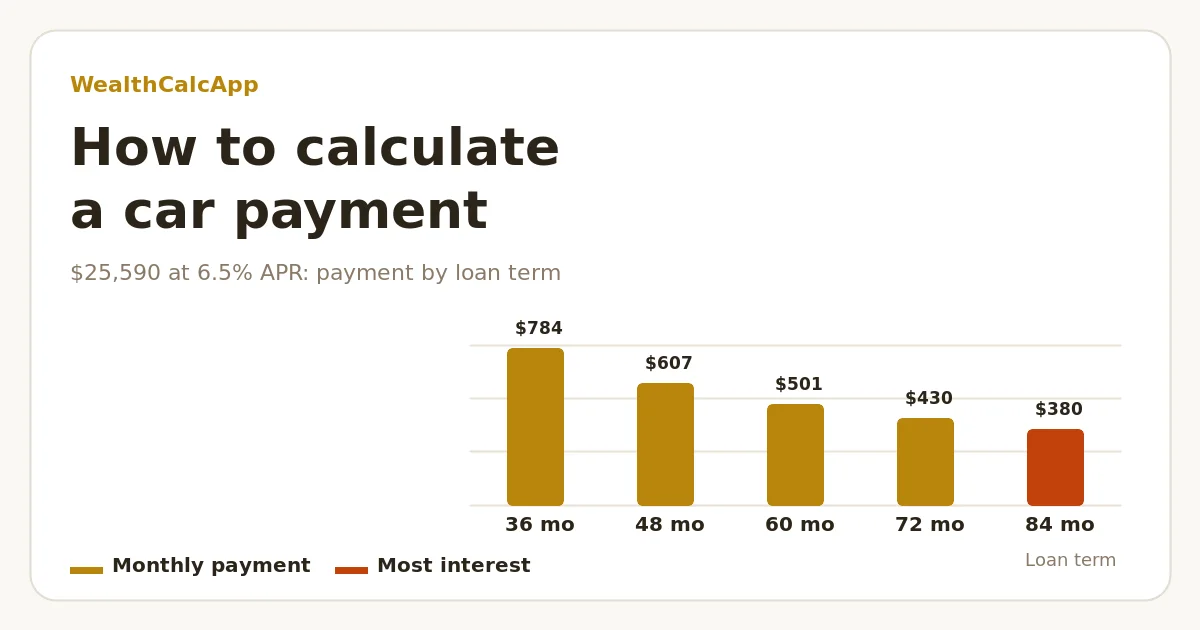
Here is the same $25,590 at 6.5% APR over different terms:
| Term | Monthly payment | Total interest | Total paid |
|---|---|---|---|
| 36 months | $784.31 | $2,645 | $28,235 |
| 48 months | $606.87 | $3,540 | $29,130 |
| 60 months | $500.70 | $4,452 | $30,042 |
| 72 months | $430.17 | $5,382 | $30,972 |
| 84 months | $380.00 | $6,330 | $31,920 |
Stretching from 60 to 84 months cuts the payment by $121 but adds almost $1,900 of interest, and in practice the gap is wider, because lenders usually charge a higher rate on longer terms. The bigger risk is time spent underwater: a new car can lose a fifth or more of its value in the first year, while a long loan pays down principal slowly, so for years you owe more than the car is worth. If it is written off or you need to sell, you have to cover the difference.
For a sense of scale, Experian reports that the average new-car loan in the second quarter of 2026 was $43,610 at 6.35% over 69.5 months, for an average payment of $765; for used cars it was $27,852 at 11.19%, with a $542 payment. On our example, a used-car rate of 11.19% would lift the 60-month payment from $500.70 to $558.82 and the interest from $4,452 to $7,939.
0% APR or a cash rebate: run both
Manufacturers often offer a choice: 0% financing, or a cash rebate if you finance elsewhere. You usually cannot have both, so compare the total paid. Say you need to finance $30,000 over 60 months:
- 0% APR: $30,000 ÷ 60 = $500.00 a month, $30,000 in total.
- $3,000 rebate and a 6.5% bank loan: $27,000 financed, $528.29 a month, $31,697 in total.
- $3,000 rebate and a 5.0% credit union loan: $509.52 a month, $30,571 in total.
Here the 0% offer wins in every case. The break-even rate, where the rebate and the 0% deal cost the same, is the rate at which $27,000 over 60 months gives a $500 payment: about 4.2%. If you can borrow below that, take the rebate; above it, take the 0%. Bigger rebates and shorter 0% terms move the line, so run the numbers every time, and remember that 0% deals usually require top-tier credit.
Whatever the offer, compare loans by APR rather than by the payment, since the APR includes fees; our explainer on APR vs APY covers the difference. Getting pre-approved by a bank or credit union before you visit the dealer gives you a rate to beat, as our guide to the best auto loans explains.
How much car payment can you afford?
Lenders will often approve more than is comfortable, so set your own ceiling first. Two common rules of thumb:
- The 20/4/10 rule: put at least 20% down, finance for no more than four years and keep total car costs, including insurance and fuel, under 10% of gross income. On $70,000 a year that is about $583 a month for everything.
- 10–15% of take-home pay for the payment alone, which is more realistic with today’s prices but still leaves room for running costs.
To turn a budget into a price, run the formula backwards:
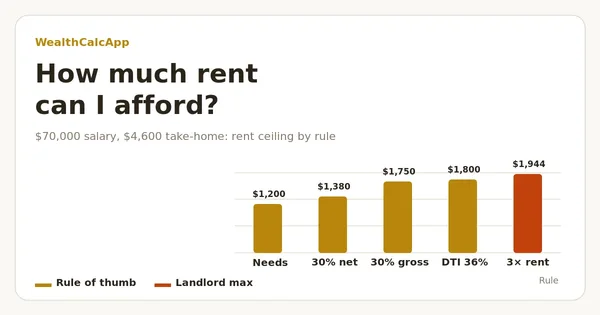
With $4,600 a month of take-home pay, 10% is $460. At 6.5%, that supports $19,397 over 48 months or $23,510 over 60. At 15%, or $690, it supports $29,096 over 48 months. Add your down payment and trade-in to find the price range to shop in.
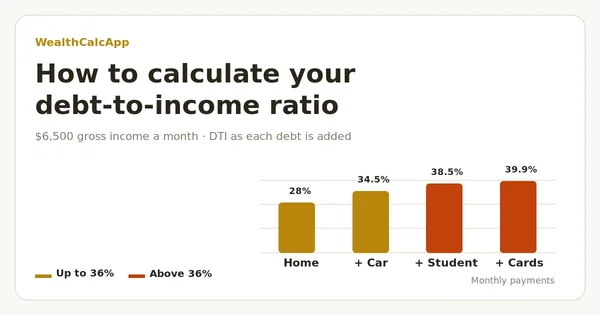
Then check the full monthly cost of ownership: insurance, fuel or charging, maintenance, registration and parking. A payment that fits on its own can still push you over budget once those are added. Lenders also look at your debt-to-income ratio, and a car loan counts towards it if you plan to apply for a mortgage later.
How a lease payment is calculated
A lease payment is not a loan payment. You pay for the depreciation you use, plus a finance charge on the money tied up in the car:
Finance fee = ([CAPITALIZED COST] + [RESIDUAL VALUE]) × [MONEY FACTOR]
Monthly payment = (depreciation fee + finance fee) × (1 + [SALES TAX RATE])
Take a car with a $36,000 sticker price, negotiated to a $34,000 capitalized cost, with a 36-month residual of 58% ($20,880) and a money factor of 0.00250:
- Depreciation: ($34,000 − $20,880) ÷ 36 = $364.44.
- Finance charge: ($34,000 + $20,880) × 0.0025 = $137.20.
- Base payment: $501.64, or $536.76 with 7% sales tax on the payment, the way most states tax leases.
Multiply the money factor by 2,400 to see it as an approximate APR: 0.0025 is about 6.0%. Dealers sometimes mark the money factor up, so ask for it in writing. Over three years you pay about $19,300 and own nothing, which is fine if you would change cars anyway and stay within the mileage limit; if you keep cars for eight or ten years, buying almost always costs less.
Cutting the cost: extra payments, refinancing and the interest deduction
Car loans in the US are generally simple-interest loans, so any extra payment goes straight to principal. Adding $50 a month to our $500.70 payment pays the loan off in 54 months instead of 60 and saves $483 of interest. Check that the contract has no prepayment penalty and tell the lender to apply the extra to principal.
If your credit score has improved or rates have fallen since you bought, refinancing can lower both the rate and the payment. Compare the new total cost, including any fees, with what is left on the current loan, and avoid extending the term so far that you pay more interest overall.
There is also a new tax break. Under the 2025 tax law, you can deduct up to $10,000 a year of interest on a loan for a new car, SUV, pickup or motorcycle whose final assembly took place in the United States, for loans taken out after 31 December 2024 and tax years 2025 to 2028. It is available whether or not you itemise, phases out above $100,000 of modified adjusted gross income ($200,000 for joint filers), and does not apply to used vehicles or leases. On our example, first-year interest is about $1,532, so in the 22% bracket the deduction is worth about $337: welcome, but not a reason to buy a more expensive car.
If you are carrying a car loan alongside other debts, our article on debt payoff strategies explains whether to clear it first or put extra money elsewhere.
Limits worth knowing
- Your rate is not the advertised rate. Headline offers assume excellent credit; a lower score can add several percentage points, which changes every figure above.
- Taxes and fees vary by state. Sales tax rates, how trade-ins are treated and dealer documentation fees differ widely, so use your own state’s figures.
- Some loans are not simple interest. Precomputed or add-on loans, still used by some buy-here-pay-here dealers, charge interest up front, so extra payments save little.
- The formula ignores ownership costs. Insurance, fuel, repairs and depreciation can cost as much as the payment itself.
- Leases have their own traps. Excess mileage, wear charges and early termination fees are not in the monthly figure.
References
- Consumer Financial Protection Bureau — Auto loans
- IRS — Purchasing a new vehicle? Car loan interest could be eligible for a tax deduction
- Wikipedia — Amortization calculator
Frequently asked questions
Passionate about finance and investing, with more than 6 years of hands-on experience in the crypto world. He shares analysis and financial education on his YouTube channel, Cripto Adicto.
Watch on YouTube →Keep reading

Calculate your car payment
Enter the amount financed, the APR and the term to see the monthly payment, the total interest and the effect of paying extra each month.
Open the Loan Calculator →