How to Calculate Loan Interest: What You’ll Really Pay, Month by Month


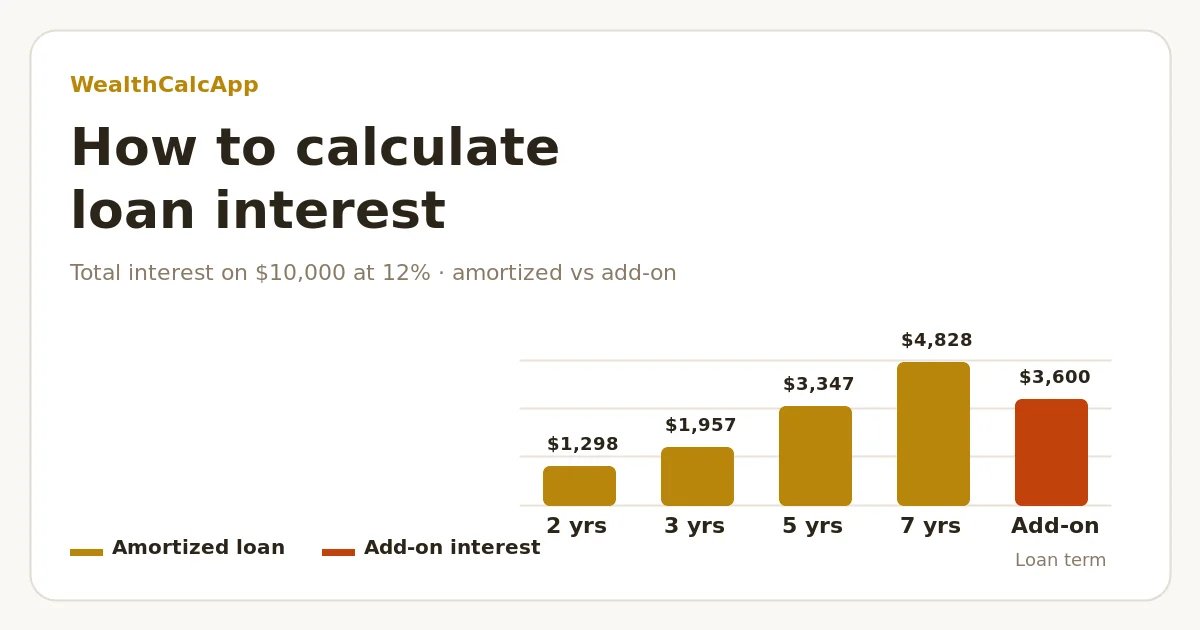
A lender offers you $10,000 at 12% for three years. How much interest is that? Most people multiply 10,000 by 12% by 3 and get $3,600. The real answer, on a normal personal loan, is $1,957, because you pay the balance down every month and interest is only charged on what you still owe. The quick multiplication is right for one type of loan, though, and it happens to be the expensive one. This guide shows how lenders actually calculate interest on personal loans and car loans, how to work out the payment and the total cost yourself, and which fees and loan types make the headline rate misleading.
Simple interest: the formula everyone starts with
Simple interest means interest is charged on the principal only, never on unpaid interest. The textbook formula is:
Example: $10,000 × 0.12 × 3 = $3,600
That formula assumes you owe the full $10,000 for the full three years. It is accurate for an interest-only loan, a loan you repay in one lump sum, or a single period of interest. For one month on $10,000 at 12% it gives $10,000 × 0.12 ÷ 12 = $100, and that is exactly how the first month of a standard loan is charged.
From month two onwards the balance is lower, so each month’s interest is lower too. Almost every US personal loan and car loan is a “simple interest” loan in this sense: interest is worked out on the outstanding balance, monthly or daily, and is never compounded on top of itself as long as you pay on time. To find the total cost you need the monthly payment first.
How lenders work out the monthly payment
An amortized loan has a fixed payment that clears the interest and the principal by the last month. The payment comes from the standard annuity formula:
r = [APR] ÷ 12 (as a decimal) · n = [NUMBER OF MONTHS]
Spreadsheet: =PMT([APR]/12, [MONTHS], -[PRINCIPAL])
For $10,000 at 12% over 36 months:
- Monthly rate: 0.12 ÷ 12 = 0.01.
- Growth factor: 1.0136 = 1.4308, so (1.01)−36 = 0.6989.
- Payment: $10,000 × 0.01 ÷ (1 − 0.6989) = $332.14 a month.
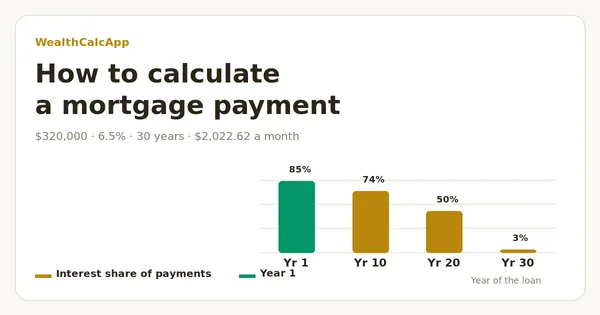
It is the same formula a mortgage uses, only over a shorter term; our guide to calculating a mortgage payment walks through it in more detail. If the lender quotes a payment that does not match your result, ask why: the gap is usually a fee added to the loan or an insurance product bundled into the payment.
Where each payment goes: the amortization schedule
Every month the lender takes that month’s interest out of your payment first and uses the rest to reduce the balance:
Principal repaid = [PAYMENT] − monthly interest
New balance = [BALANCE] − principal repaid
| Month | Payment | Interest | Principal | Balance left |
|---|---|---|---|---|
| 1 | $332.14 | $100.00 | $232.14 | $9,767.86 |
| 2 | $332.14 | $97.68 | $234.46 | $9,533.39 |
| 3 | $332.14 | $95.33 | $236.81 | $9,296.58 |
| 12 | $332.14 | $73.15 | $258.99 | $7,055.84 |
| 36 | $332.14 | $3.29 | $328.85 | $0.00 |
Interest falls every month because the balance does. In the first year you pay $1,041.56 of interest, 53% of the loan’s total, while the balance drops by less than $3,000. That front-loading matters if you plan to repay early or refinance: by month 12 you have already paid more than half of the interest the loan will ever charge.
Total interest: the one-line formula
Once you know the payment, the total interest is simply everything you pay minus what you borrowed:
Example: $332.14 × 36 − $10,000 = $1,957.15
The term has a bigger effect on the total than most borrowers expect. Here is the same $10,000 at 12% over different terms:
| Term | Monthly payment | Total interest | Interest per $1 borrowed |
|---|---|---|---|
| 1 year | $888.49 | $661.85 | $0.07 |
| 2 years | $470.73 | $1,297.63 | $0.13 |
| 3 years | $332.14 | $1,957.15 | $0.20 |
| 5 years | $222.44 | $3,346.67 | $0.33 |
| 7 years | $176.53 | $4,828.30 | $0.48 |
Stretching from three to five years cuts the payment by $110 but adds $1,390 of interest. Longer terms often carry a higher rate as well, which makes the gap wider still. Choose the shortest term whose payment fits comfortably in your budget, not the lowest payment on offer.
Daily interest on car loans
Many auto loans and some personal loans use daily simple interest: the lender charges interest for each day between payments rather than a flat twelfth of the APR each month. The calculation is:
Interest for a period = daily interest × [DAYS SINCE LAST PAYMENT]
According to the Federal Reserve’s G.19 release of 7 October 2026, commercial banks charged an average of 7.54% on 60-month new car loans in August 2026. On a $30,000 balance at 7.5%, interest builds up at about $6.16 a day, and the five-year payment is $601.14, with $6,068 of interest in total.
- Paying late costs more than the late fee. Ten days late means about $62 more interest, and that comes out of the principal portion of your payment, so the balance falls more slowly.
- Paying early saves a little. Pay a few days before the due date each month and less interest accrues, so more of each payment reduces the balance.
- Months are not equal. A 31-day month costs slightly more interest than a 28-day one, which is why the split on your statement varies from month to month.
Add-on and precomputed interest: the expensive versions
With add-on interest the lender does use principal × rate × time on the original amount, adds the result to the loan and divides the total by the number of payments:
Payment = ([PRINCIPAL] + add-on interest) ÷ [NUMBER OF MONTHS]
Example: ($10,000 + $3,600) ÷ 36 = $377.78 a month
That is $45.64 a month more than the amortized loan at the same quoted 12%, because you pay interest on money you have already returned. Expressed as a true APR, the add-on loan costs 21.2%. Truth in Lending rules require the lender to disclose that APR, so compare it, not the add-on rate. Add-on loans still appear at some used-car dealers, furniture stores and small-loan shops.
A related method is precomputed interest, where the total interest is fixed at the start. If you repay early, the refund of unearned interest may be calculated with the Rule of 78s, which assigns most of the interest to the early months. Repay the $3,600 add-on loan after 12 of 36 months and the lender treats $1,978, or 55% of the interest, as already earned. Federal law bans the Rule of 78s on precomputed consumer loans longer than 61 months, but not on shorter ones.
Fees and APR: the number to compare
The interest rate tells you what the lender charges on the balance; the APR also counts fees such as an origination fee, so it is the figure to compare between offers. Origination fees on personal loans commonly run from 1% to 10% and are usually deducted from the amount you receive:
- You borrow $10,000 at 12% for 36 months, with a 5% origination fee.
- You receive $9,500, but the payment is still $332.14, calculated on $10,000.
- Total cost: $11,957 repaid for $9,500 received, which is $2,457 rather than $1,957.
- True APR: 15.61%, not 12%.
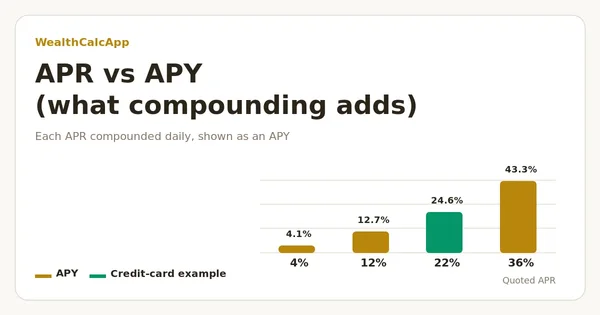
The Fed’s G.19 figure for 24-month personal loans at commercial banks was 11.90% in August 2026; online lenders quote anything from single digits to over 35% depending on credit score. Note that a US APR is the monthly rate × 12, so it does not include compounding: a 12% APR is a 12.68% effective annual rate. Our article on APR vs APY explains the difference, and how credit card interest is calculated shows the same daily method applied to revolving debt.
How to pay less interest
The formulas also show where the savings are. With the $10,000, 12%, three-year loan as the baseline:
- Pay a little extra each month. $50 extra clears the loan in 31 months instead of 36 and saves $305 of interest; $100 extra clears it in 27 months and saves $526. Check first that the loan has no prepayment penalty and that extra payments go to principal.
- Choose the shorter term. Two years instead of three saves $660 at the same rate, if the $471 payment fits your budget.
- Improve the rate before you borrow. At 9% the same loan costs $1,448 in interest, about $509 less. Paying down cards and correcting credit report errors can move you up a pricing tier.
- Refinance when rates or your credit improve. Count any new origination fee: refinancing late in a loan saves little, because most of the interest has already been paid.
To see the effect on your own loan, open this example in the loan calculator with $50 a month extra and change the figures. Before taking on new debt, check your debt-to-income ratio, and if you are juggling several loans, our guide to debt payoff strategies compares the avalanche and snowball methods.
Limits worth knowing
- Variable-rate loans change. The formulas here assume a fixed rate. If the rate resets, the payment or the term changes and the schedule has to be recalculated from that point.
- Day-count rules vary. Some lenders use 365 days, some 360, and some charge exactly 1/12 of the APR each month. The differences are small but explain why your statement may not match a calculator to the cent.
- Late payments break the schedule. Late fees, deferred payments and missed months add interest the original schedule does not show.
- Add-ons are not in the rate. Credit insurance, extended warranties and GAP cover rolled into a car loan raise the amount you borrow and the interest on it.
- Our calculator simplifies. It uses a fixed rate, monthly interest and no fees, so treat its results as estimates and rely on the lender’s Truth in Lending disclosure for the exact figures.
References
- Consumer Financial Protection Bureau — Simple interest vs precomputed interest on an auto loan
- Federal Reserve — G.19 Consumer Credit (terms of credit)
- Wikipedia — Rule of 78s
Frequently asked questions
Passionate about finance and investing, with more than 6 years of hands-on experience in the crypto world. He shares analysis and financial education on his YouTube channel, Cripto Adicto.
Watch on YouTube →Keep reading

Work out the interest on your loan
Enter the amount, rate and term to see your monthly payment, the total interest and how much an extra payment saves, with the full schedule.
Open the Loan Calculator →