
How Much Rent Can I Afford? The 30% Rule, the 3× Test and Your Real Budget


Ask a landlord how much rent you can afford and you will get one answer; ask your bank balance at the end of the month and you may get another. The usual guideline, 30% of gross income, is a reasonable starting point, but it was designed to measure housing stress across the population, not to set your personal budget. This guide works through the three tests that matter: the 30% rule, the income multiple landlords use to approve you, and a budget built from your take-home pay. Along the way it covers what counts as rent, how debts and upfront costs change the figure, and what to do when the numbers simply do not fit your city.
The quick answer: the 30% rule
The most quoted rule says your rent should be no more than 30% of your gross monthly income, that is, your pay before tax:
Income needed = [MONTHLY RENT] × 12 ÷ 0.30
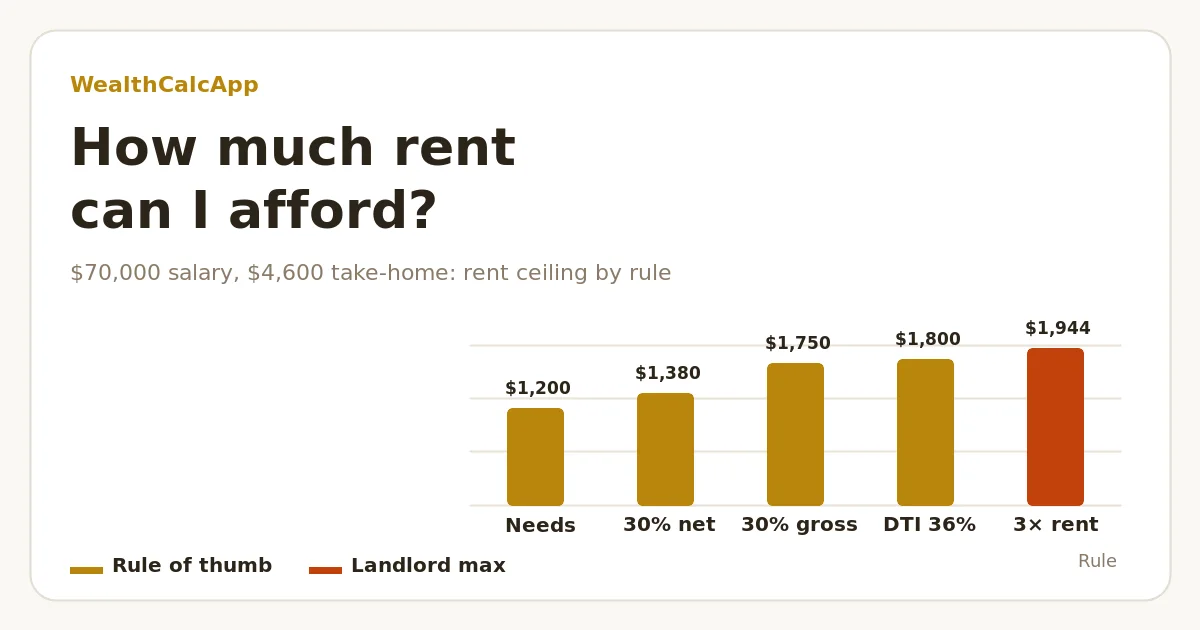
On a $70,000 salary, gross monthly income is $5,833, so the 30% ceiling is $1,750. Turned round, a $1,500 apartment needs an income of $60,000. Here is the rule across a range of salaries:
| Annual gross income | Monthly gross | 30% rule: max rent | Landlord 3× test: max rent |
|---|---|---|---|
| $35,000 | $2,917 | $875 | $972 |
| $50,000 | $4,167 | $1,250 | $1,389 |
| $70,000 | $5,833 | $1,750 | $1,944 |
| $90,000 | $7,500 | $2,250 | $2,500 |
| $120,000 | $10,000 | $3,000 | $3,333 |
The figure comes from US housing policy. The Department of Housing and Urban Development treats a household as cost-burdened when housing takes more than 30% of income and severely cost-burdened above 50%. By that measure, Harvard’s Joint Center for Housing Studies counted a record 22.7 million renter households, 49% of the total, as cost-burdened in 2024. So the rule is a line between comfortable and stretched, not a target to spend up to.
What counts as rent
HUD’s definition uses gross rent: the rent plus utilities you pay separately. The advertised figure is rarely the full monthly cost, so before comparing anything with your income, build the real number:
+ [PARKING] + [PET RENT] + [AMENITY OR TRASH FEES]
A $1,550 one-bedroom with $160 of electricity, gas and water, $15 of renters insurance, a $50 parking space and a $25 amenity fee really costs $1,800 a month. Against a $1,750 ceiling, it fails the test even though the listing looked comfortable. Ask the landlord for the average utility bills for the unit, or check with the utility company, because older buildings with electric heating can cost far more than the national average in winter.
Internet and a phone plan are usually budgeted separately, but if the building bundles them into a fee, include it. And if a listing offers “one month free” on a 13-month lease, divide the total rent by 13 to find the effective monthly figure, but budget for the full amount, which is what you will pay from month two and what the next renewal will be based on.
The landlord test: 3× the rent (and 40× in New York)
Landlords and property managers rarely mention 30%. Most use an income multiple instead, typically that your gross monthly income is at least three times the rent:
Maximum rent they will approve = [GROSS MONTHLY INCOME] ÷ 3
Dividing by three means a rent of 33.3% of gross income, slightly more generous than the 30% rule: on $70,000, landlords will usually approve you for up to $1,944. In New York City the convention is that your annual income should be 40 times the monthly rent, and a guarantor’s 80 times. Since 12 ÷ 40 is exactly 30%, the 40× rule is the 30% rule in disguise: $70,000 ÷ 40 = $1,750.
Expect the landlord to check pay stubs or an offer letter, tax returns if you are self-employed, a credit report and sometimes rental references. Roommates can usually combine incomes, but each person may be screened separately. If you fall short, a guarantor, a larger deposit where the law allows it or a paid guarantor service can bridge the gap, although the last costs a non-refundable fee.
A better method: budget from take-home pay
Rules based on gross income ignore taxes, retirement contributions and health insurance premiums, which vary a lot between people with the same salary. Working from the money that actually reaches your account is more honest. Our guide to take-home pay and taxes explains how to find your net figure; on $70,000 in a typical state it is about $4,600 a month.
The 50/30/20 framework puts 50% of take-home pay towards needs, 30% towards wants and 20% towards savings and extra debt repayment. Rent has to fit inside the needs half alongside everything else you cannot avoid:
− [HEALTH COSTS] − [MINIMUM DEBT PAYMENTS]
- Needs budget: $4,600 × 50% = $2,300.
- Other needs: $400 groceries, $200 transport, $100 phone and internet, $100 health costs and a $300 student loan payment, $1,100 in total.
- Left for rent and utilities: $2,300 − $1,100 = $1,200.
That is well below the $1,750 the 30% rule suggests, and it shows why so many people who follow the rule still feel squeezed. A simpler check is 30% of take-home pay, $1,380 here. You can try your own split with the budget calculator, filled in with this example.
In practice, the take-home figure is your comfortable rent, the 30% of gross figure is a stretch you can manage if your other costs are low, and the landlord’s 3× figure is the most you will be allowed to sign for. On $70,000 that gives a range of roughly $1,200 to $1,950, and where you settle in it is a choice about how much you want to save.
How debts change the answer
Two people on the same salary can afford very different rents if one has a car loan and the other does not. A useful cross-check borrows the lender’s view: keep housing plus all minimum debt payments under 36% of gross income.
With $5,833 of gross income and a $300 student loan, the ceiling is $2,100 − $300 = $1,800. Add a $450 car payment and it falls to $1,350, below the 30% rule. This matters beyond renting: if you hope to buy within a few years, lenders will look at your debt-to-income ratio, and a high rent leaves less room to pay debts down and build a deposit.
Credit card balances deserve special attention. A minimum payment of $100 on a $3,000 balance hides an interest bill of around $60 a month at today’s rates. Clearing it before you move can free more money each month than haggling $50 off the rent.
Upfront costs: the cash you need to move in
Affording the monthly rent is only half the test; you also need the cash to move. For a $1,700 apartment, a typical bill looks like this:
- First month’s rent: $1,700.
- Security deposit: often one month, $1,700. Some states cap it: New York at one month since 2019, and California at one month for most landlords since July 2024.
- Application and screening fees: $30 to $75 per application, so $100 if you apply twice.
- Moving: $800 for a local move with a small crew, less if you hire a van and friends.
- Utility set-up and deposits: about $100.
That is about $4,400 before furniture, and more where landlords ask for last month’s rent or a broker’s fee. In New York City, the FARE Act has made landlords pay the fee of a broker they hire since June 2025, but you may still pay if you hire your own. Do not drain your emergency fund to cover the move: a new home is exactly where unexpected costs appear, and a rent you can only afford with no savings left is not affordable.
When 30% is impossible: renting in an expensive city
In much of New York, San Francisco, Boston or Miami, a one-bedroom costs more than 30% of a typical salary, and the rule cannot be met by living alone. Rather than abandon it, change the variables:
- Share. A $2,800 two-bedroom split equally is $1,400 each, against $1,950 for a one-bedroom on your own.
- Count the commute. The Center for Neighborhood Technology’s H+T index suggests keeping housing plus transport under 45% of income. On $5,833 that is $2,625: at $1,750 rent you have $875 for transport, but a cheaper flat an hour away that needs a car can cost more overall.
- Negotiate. Offer a longer lease, an earlier start or a flexible move-in date in exchange for a lower rent, especially in winter when demand is weaker.
- Raise the income side. If you are paid by the hour, our guide to converting hourly pay to salary helps you see how extra shifts or a raise change the annual figure landlords use.
If you do go above 30%, decide in advance what gives way. Spending 40% on rent can work for a year or two early in a career, provided you still save something and the higher cost buys you a shorter commute or a better-paid job.
Renting or buying with the same budget
Rent is not fixed. Most leases renew annually, and a 4% rise each year turns $1,750 into $1,820, $1,893 and then $1,969 by the fourth year. Budget for the renewal you are likely to face, not just this year’s rent, and check whether your city or state limits increases.
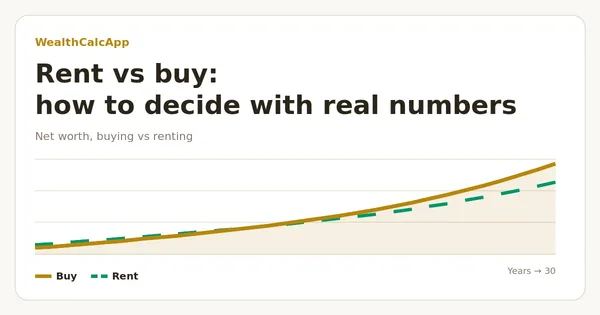
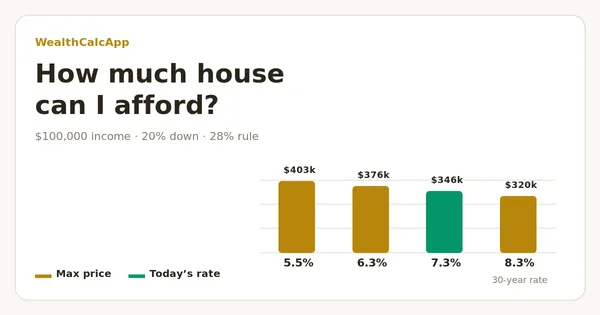
Once you know what you can comfortably pay each month, it is worth comparing it with the cost of owning. Our article on renting versus buying explains why the answer depends on how long you stay, and the rent vs buy calculator, starting from a $1,750 rent, compares the two paths over time. If buying looks possible, see how much house you can afford, which applies the same income tests to a mortgage payment, property tax and insurance.
Limits worth knowing
- Rules of thumb ignore your circumstances. Childcare, medical costs, supporting family or an irregular income can make 30% far too much; low costs elsewhere can make it too little.
- Gross income flatters high earners. At $200,000, 30% leaves plenty for everything else; at $35,000, the same share can leave too little for food and transport.
- Utilities and fees vary. The figures here are examples; use the real bills and fees for the unit you are considering.
- Local rules differ. Deposit caps, fee rules and rent increase limits depend on your state and city, so check the local tenant rules before you sign.
- The rent is only part of the cost. Renters insurance, moving and renewals all add up, and none of them appear on the listing.
References
- US Census Bureau — Nearly half of renter households are cost-burdened
- Center for Neighborhood Technology — H+T Affordability Index
- Wikipedia — Affordable housing
Frequently asked questions
Passionate about finance and investing, with more than 6 years of hands-on experience in the crypto world. He shares analysis and financial education on his YouTube channel, Cripto Adicto.
Watch on YouTube →Keep reading

Find a rent that fits your budget
Enter your monthly take-home pay and see how much the needs, wants and savings buckets leave for rent with the 50/30/20 rule.
Open the Budget Calculator →