
How to Calculate Loan-to-Value Ratio: The Number Behind Your Rate and PMI


When you apply for a mortgage, lenders look at three numbers: your credit score, your debt-to-income ratio and your loan-to-value ratio (LTV). LTV is the one you control most directly, because it is simply how much you borrow compared with what the home is worth. It decides whether you pay private mortgage insurance, which loan programmes you qualify for and which price band your rate falls into. Years later it decides whether you can drop PMI, refinance or borrow against the house. This guide shows how to calculate LTV properly, including the details that catch buyers out: the low appraisal, the rounding rule, the exact month PMI can come off, and the combined ratio lenders use once you add a HELOC.
The LTV formula, step by step
LTV is the loan amount divided by the value of the property, expressed as a percentage. The only subtle part is which value counts. For a purchase, Fannie Mae’s Selling Guide uses the lower of the sales price and the appraised value. For a refinance there is no sale price, so the current appraisal is used on its own.
Down payment % = 100 − LTV (only true when the appraisal is at or above the price)
Maximum loan = [VALUE] × [TARGET LTV]
Example: you buy a $400,000 home with $40,000 down. The loan is $360,000, and 360,000 ÷ 400,000 = 0.90, so the LTV is 90%. If you put down $80,000 instead, the loan is $320,000 and the LTV is exactly 80%.
Two details matter at the margins. First, Fannie Mae truncates the result to two decimals and then rounds up to the next whole percent, so 80.01% is treated as 81%. One dollar over the line counts as being over it. Second, anything you roll into the loan, such as FHA’s upfront mortgage insurance premium or the VA funding fee, increases the loan amount and the ratio for the purposes that use the total loan.
When the appraisal comes in below the price
The “lower of price or appraisal” rule is why a low appraisal hurts. The lender does not care what you agreed to pay; it lends against what the appraiser says the home is worth. Here is the same purchase with an appraisal $15,000 below the contract price:
| Appraisal at price | Appraisal $15,000 short | |
|---|---|---|
| Purchase price | $400,000 | $400,000 |
| Appraised value | $400,000 | $385,000 |
| Loan of $360,000: LTV that counts | 90% | 93.51% → 94% |
| Loan that keeps LTV at 90% | $360,000 | $346,500 |
| Cash needed for 90% LTV | $40,000 | $53,500 |
So the shortfall is not $15,000 of value but $13,500 of extra cash at closing if you want to keep the same ratio, or a higher LTV with more expensive mortgage insurance if you do not. Your options are to renegotiate the price, pay the gap, ask the lender for a reconsideration of value with better comparable sales, or walk away if your contract has an appraisal contingency. An appraisal above the price does not help a purchase: the price is still the lower number.
The LTV lines that change your loan
LTV is not a pass-or-fail test. A few lines change what you pay, and they are worth knowing before you decide how much to put down:
| LTV | What changes |
|---|---|
| 60% or less | Usually the best pricing band on conventional rate sheets. |
| 80% or less | No private mortgage insurance on a conventional loan. Also the usual ceiling for a cash-out refinance of a one-unit main home. |
| 80.01% to 95% | Conventional loan with PMI; the premium rises as LTV rises. |
| Up to 97% | Conventional, but only through Fannie Mae’s 97% LTV options (HomeReady, or the standard option when at least one borrower is a first-time buyer). |
| Up to 96.5% | FHA with 3.5% down. Above 90% LTV, the annual premium (0.55% on most 30-year loans) lasts for the life of the loan; at 90% or less it stops after 11 years. |
| Up to 100% | VA and USDA loans, with a funding or guarantee fee instead of a down payment. |
Beyond mortgage insurance, Fannie Mae and Freddie Mac charge loan-level price adjustments that combine your credit score with LTV bands roughly five points wide above 60%. Lenders pass them on as a slightly higher rate or as points. That is why going from 81% to 80% can help twice: no PMI and a cheaper pricing band. With 30-year rates around 7.11% in mid-November 2026, every tenth of a point is worth checking on the Loan Estimate.
How LTV decides when PMI comes off
For conventional loans on a main home closed since 29 July 1999, the Homeowners Protection Act sets three dates, all measured against the original value (the lower of price and appraisal at purchase), according to the CFPB:
- 80%: you can ask. You may request cancellation in writing on the date the balance is scheduled to reach 80% of the original value, or earlier if extra payments get you there. You need a good payment history, no second liens, and you may have to show the value has not fallen.
- 78%: it ends automatically on the date the balance is scheduled to reach 78%, as long as you are current.
- Midpoint: final termination. PMI must end the month after the midpoint of the amortisation schedule, 15 years into a 30-year loan, even if you have not reached 78%.
In our example, $360,000 at 7.11% over 30 years costs $2,421.74 a month in principal and interest. The scheduled balance reaches $320,000 (80% of $400,000) after 102 payments, about 8.5 years, and $312,000 (78%) after 117 payments, about 9.8 years. Paying an extra $200 a month brings the 80% date forward to payment 67 (5.6 years); $500 a month, to payment 45 (3.8 years). You can see the effect on the balance in the mortgage calculator, which is pre-filled with this example and $200 of extra principal.
There is also a current-value route. On loans owned by Fannie Mae, you can ask to cancel PMI based on a new valuation if your LTV is 75% or less and the loan is two to five years old, or 80% or less after five years. If prices in our example rose 3% a year, the LTV on current value would fall below 75% after about 54 months. Substantial improvements, such as a kitchen remodel or an extension, can waive the two-year wait if LTV is 80% or less. FHA works differently: if you put down less than 10%, the premium only goes if you refinance into another loan.
CLTV and HCLTV when there is a second loan
Once you add a second loan secured by the home, such as a home equity loan, a HELOC or a piggyback mortgage, lenders look at two more ratios. Combined LTV (CLTV) adds the balances of every loan secured by the property. HCLTV uses the full credit limit of a HELOC, not just what you have drawn, because you can draw the rest at any time.
HCLTV = ([FIRST MORTGAGE] + [FULL HELOC LIMIT] + [OTHER LOAN BALANCES]) ÷ [VALUE] × 100
Example: a home worth $500,000 with a $300,000 first mortgage and a $75,000 HELOC of which $25,000 is drawn. LTV is 300,000 ÷ 500,000 = 60%. CLTV is 325,000 ÷ 500,000 = 65%. HCLTV is 375,000 ÷ 500,000 = 75%. Most home equity lenders cap CLTV somewhere between 80% and 90%. At 85%, the most this owner could have secured against the house in total is $425,000, so with the same first mortgage the HELOC limit could have been as high as $125,000 rather than $75,000.
The same arithmetic explains the 80-10-10 piggyback: an 80% first mortgage avoids PMI, a 10% second loan covers part of the down payment, and the CLTV is 90%. Compare the second loan’s rate with what PMI would cost before assuming it is cheaper.
How your LTV falls over time
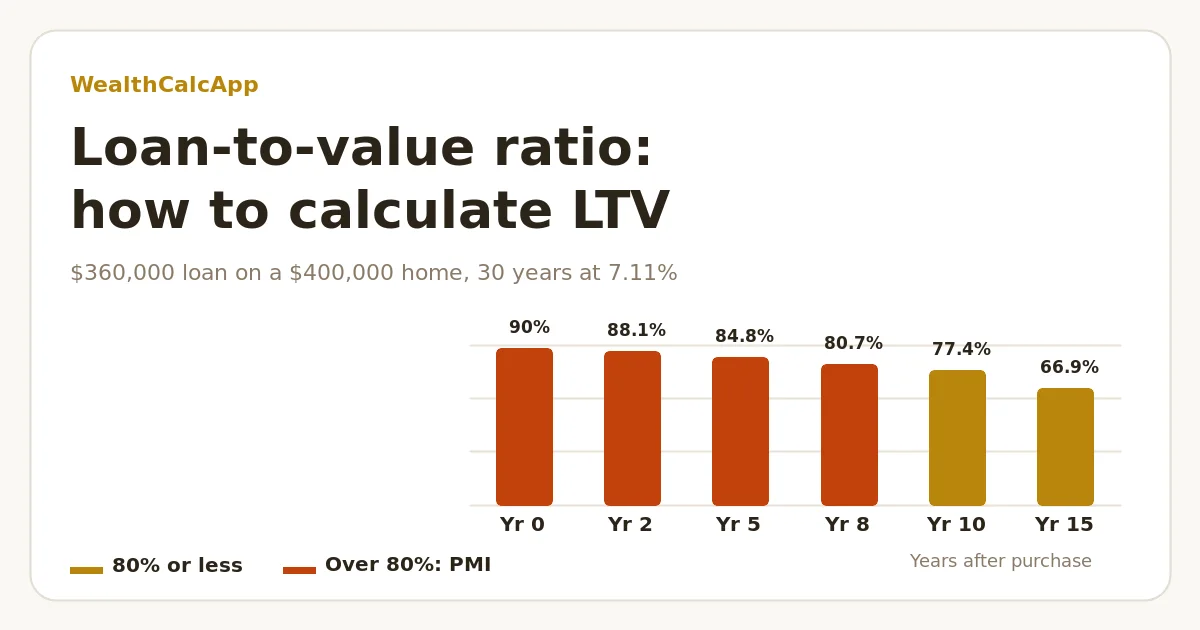
After closing, two forces move your LTV: you pay the loan down, and the home’s value changes. Lenders measuring PMI under the Homeowners Protection Act only use the first. A new valuation, for a refinance or a HELOC, uses both. Here is our $360,000 loan at 7.11%:
| Years after purchase | Balance | LTV on original $400,000 | LTV if prices rise 3% a year |
|---|---|---|---|
| 0 | $360,000 | 90.0% | 90.0% |
| 2 | $352,577 | 88.1% | 83.1% |
| 5 | $339,269 | 84.8% | 73.2% |
| 8 | $322,808 | 80.7% | 63.7% |
| 10 | $309,719 | 77.4% | 57.6% |
| 15 | $267,599 | 66.9% | 42.9% |
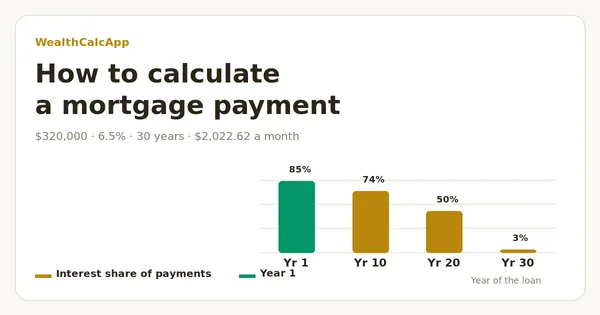
Amortisation alone is slow at first: in the first five years only about $21,000 of principal is repaid, because most of each payment is interest. Our guide on how to calculate a mortgage payment shows the split month by month. Prices do the heavy lifting when they rise, and they work in reverse when they fall: a 10% drop in value takes a fresh 90% loan to 100%, with no equity left to sell or refinance.
The value minus every loan secured on the home is your home equity, the figure that goes into your net worth. A falling LTV and rising equity are the same thing seen from two sides.
LTV when you refinance or take cash out
A refinance is underwritten on a new appraisal, so the LTV is the new loan divided by today’s value. That can work for you: if prices have risen, a rate-and-term refinance at 80% or less removes PMI or FHA premiums on the new loan. For cash out, work out the ceiling first:
Example: 500,000 × 80% − 300,000 = $100,000 before closing costs
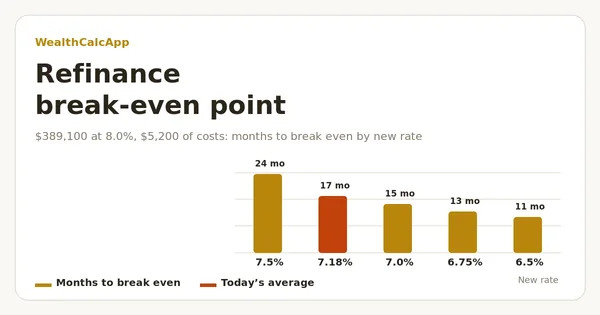
The ceiling is not the whole story. Swapping a 3% mortgage for a 7% one on the full balance to release $100,000 can cost far more in interest than a HELOC on the $100,000 alone, even at a higher rate. Run the numbers on the whole balance, and use the refinance break-even point to compare the costs with the monthly saving.
Limits worth knowing
- LTV is one of three numbers. A 70% LTV will not rescue an application with a high debt-to-income ratio or a weak credit score.
- The value is an opinion. Appraisals differ, and an automated estimate is not an appraisal. Treat any LTV based on a website’s estimate as a rough guide.
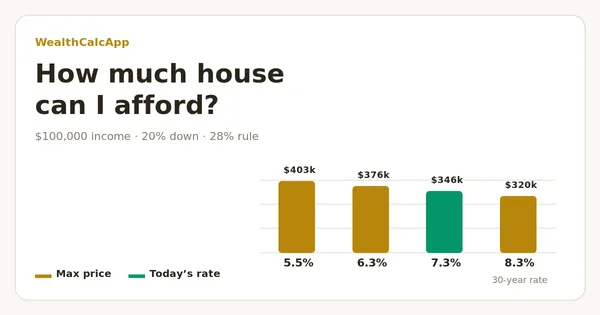
- A low LTV is not the same as affordable. Emptying your savings to reach 80% can leave you without an emergency fund; check how much house you can afford as a whole.
- Rules change by loan type and lender. The lines above are the common ones; lenders may add stricter overlays, and investment properties and multi-unit homes have lower limits.
- Other countries use different values. In Germany the ratio is measured against a lending value set below market value, so a German 80% is stricter than an American one.
References
- Fannie Mae Selling Guide — B2-1.2-01, Loan-to-Value (LTV) Ratios
- CFPB — When can I remove private mortgage insurance (PMI) from my loan?
- Wikipedia — Loan-to-value ratio
Frequently asked questions
Passionate about finance and investing, with more than 6 years of hands-on experience in the crypto world. He shares analysis and financial education on his YouTube channel, Cripto Adicto.
Watch on YouTube →Keep reading
See when your loan reaches 80%
Enter the price, your down payment and rate, then add extra principal to see how much sooner your balance reaches 80% of the home’s value and how much interest you save.
Open the Mortgage Calculator →