Refinance Break-Even Point: How to Tell If Refinancing Actually Pays Off


A lender who says a refinance will “save you $346 a month” is usually right about the payment and silent about the rest. Refinancing replaces your mortgage with a new one, and the new one comes with closing costs, a fresh schedule and often three or four extra years of payments. The question that decides whether it is worth it is simple: how many months of savings does it take to earn back what you pay to refinance, and will you still own the house by then? This guide works it out on one example, a $400,000 loan taken out at 8.0% in late 2023, from the quick break-even formula to the trap of restarting a 30-year term, points, no-closing-cost offers and what today’s rates of around 7% mean for the decision.
The short answer: closing costs ÷ monthly savings
The break-even point is the number of months it takes for the lower payment to repay the cost of getting it:
Use principal and interest only (P&I). Property tax and homeowners insurance stay the same whoever holds the mortgage, so including them in the payment changes nothing except your confusion. Then compare the result with how long you expect to keep the loan:
- You stay well past the break-even point: the refinance is likely worth it.
- You might sell or move within that time: you pay the costs and leave before collecting the savings.
- The break-even is more than five or six years away: a lot can change in that time, including rates falling further and making a second refinance tempting.
Rules of thumb such as “refinance when rates drop by 1%” are just crude versions of this formula. A 0.5-point drop on a large balance with low costs can pay off sooner than a 1-point drop on a small one.
A worked example: from 8.0% to 7.0%
In late 2023, just after the Freddie Mac weekly average peaked at 7.79%, a buyer with an average credit file took a $400,000 30-year fixed loan at 8.0%. The payment is $2,935 a month. Three years and 36 payments later, the balance is $389,100: barely $11,000 of principal repaid, against almost $95,000 of interest.
A lender now offers a new 30-year loan at 7.0% with $5,200 of closing costs, paid in cash:
| Current loan | Refinance | |
|---|---|---|
| Balance | $389,100 | $389,100 |
| Rate | 8.0% | 7.0% |
| Months left | 324 | 360 |
| Monthly P&I | $2,934.90 | $2,588.69 |
| Monthly saving | $346.21 | |
| Closing costs | $5,200 |
Break-even is $5,200 ÷ $346.21 = 15.0 months. If you stay in the house for at least a year and a half, you get your money back. A slightly stricter version counts the fact that the new loan repays principal a little more slowly at first; comparing what you have paid plus what you still owe in each case, the refinance pulls ahead after 17 months. After five years it has left you $13,358 better off, and after ten years $29,182.
You can check both payments with the loan calculator or the formula in our guide on how to calculate a mortgage payment.
The trap: a lower payment is not the same as a saving
The example has a catch that the monthly figure hides. The current loan has 27 years left; the new one restarts the clock at 30. Part of the $346 “saving” is simply the debt being spread over three more years, and over the full life of the loans the difference is much smaller than the monthly gap suggests:
| Option | Monthly P&I | Total still to pay | Lifetime saving |
|---|---|---|---|
| Keep the 8.0% loan (27 years) | $2,934.90 | $950,909 | — |
| Refinance at 7.0% over 30 years | $2,588.69 | $937,129 incl. costs | $13,779 |
| Refinance at 7.0% over 27 years | $2,676.29 | $872,317 incl. costs | $78,591 |
Same rate, same costs, but keeping the original payoff date saves almost six times as much. At a smaller rate drop the reset can wipe out the benefit completely: refinancing to 7.25% over 30 years lowers the payment by $281 a month yet costs $9,857 more over the life of the loan. Our guide to calculating loan interest explains why the length of a loan matters as much as its rate.
There are three ways to avoid the trap. Ask for a term that matches what you have left (many lenders offer 20-, 25- or custom-term loans). Take the 30-year loan for flexibility but keep paying your old amount, so the extra goes to principal. Or invest the monthly difference deliberately, which is the trade-off covered in pay off the mortgage or invest. You can try the 27-year version in the loan calculator, filled in with this example.
What counts as closing costs (and what does not)
The cost side of the formula is where most break-even calculations go wrong, usually by being too optimistic. In the example the $5,200 is made up of:
| Cost | Example | Notes |
|---|---|---|
| Lender fees (origination, underwriting) | $1,800 | Negotiable; compare them on the Loan Estimate |
| Appraisal | $650 | Sometimes waived on a streamline or low-LTV refinance |
| Title insurance and settlement | $2,300 | A new lender’s title policy is required; ask for a reissue rate |
| Recording fees and taxes | $450 | Mortgage recording taxes can run into thousands in a few states |
For the third-party part alone, the LodeStar 2026 report put the national average for refinances at $2,207 in 2025, about 0.67% of the loan, with New York the outlier at $10,553. Lender fees and any discount points come on top, which is why all-in figures of 1.5% to 3% of the balance are common.
Two items on the closing statement are not costs and should stay out of the formula: prepaid interest and the deposit into a new escrow account. You would pay that interest anyway, and the escrow balance on your old loan is refunded to you a few weeks after it is paid off. Rolling the costs into the new loan does not make them disappear either: borrowing the $5,200 at 7.0% cuts the monthly saving to $311.62 and pushes break-even to about 17 months.
Points and no-closing-cost loans: two more break-evens
Most refinance offers let you trade cash for rate in both directions, and each trade has its own break-even point:
No-cost break-even (months) = [CLOSING COSTS AVOIDED] ÷ [EXTRA MONTHLY COST OF THE HIGHER RATE]
Buying points. One point costs 1% of the loan, here $3,891, and might lower the rate from 7.0% to 6.75%. That saves $65 a month, so the point takes 60 months to pay for itself, on top of the 15 months for the closing costs. Points reward people who are sure they will keep the loan for many years and not refinance again if rates fall.
No-closing-cost refinance. The lender covers the $5,200 in exchange for a higher rate, say 7.25%. The payment is $65.66 higher than at 7.0%, so paying the costs yourself only beats the no-cost option after about 79 months. If you expect to move or refinance again within six years, the higher rate with no costs is the better deal, and it breaks even immediately.
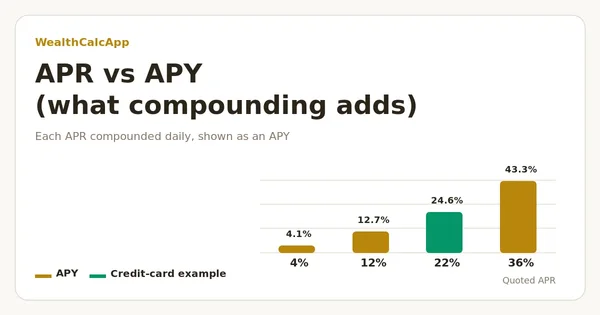
Because these trades change both the rate and the fees, compare offers on their APR as well as their rate; our explainer on APR vs APY covers what the APR includes. Your credit score moves the price of every option, so check it before applying: our credit score guide explains which factors you can still improve.
When the reason is not the rate
Some refinances are worth doing at the same rate or even a higher one, because they fix something else. The break-even logic still applies; only the monthly saving changes.
- Removing FHA mortgage insurance. FHA loans taken out with less than 10% down charge an annual premium for the life of the loan. Once you have 20% equity, refinancing into a conventional loan removes it. On a $389,100 balance a 0.55% premium is about $178 a month, which goes into the saving.
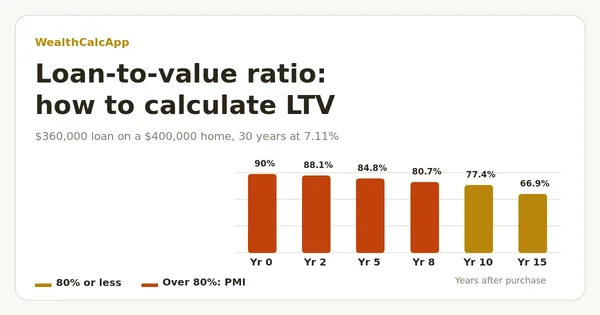
- Private mortgage insurance on a conventional loan. Usually no refinance is needed: under the Homeowners Protection Act you can ask to cancel PMI at 80% of the original value, and it ends automatically at 78%. If your home has risen in value, ask the lender about a new appraisal first.
- Moving from an adjustable to a fixed rate. The saving is uncertain, so the decision is about risk: the cost of the refinance buys a payment that cannot rise.
- Shortening the term. A 15-year loan at around 6.5% raises the example payment to $3,389 but cuts the total still to pay from $950,909 to about $615,300. The break-even is immediate in interest terms; the test is whether the budget can carry it.
- Cash-out refinancing. Replacing a cheap mortgage with a bigger, dearer one to release equity reprices the whole balance. If your current rate is low, a home equity loan or HELOC on the extra amount is often cheaper.
Is refinancing worth it at today’s rates?
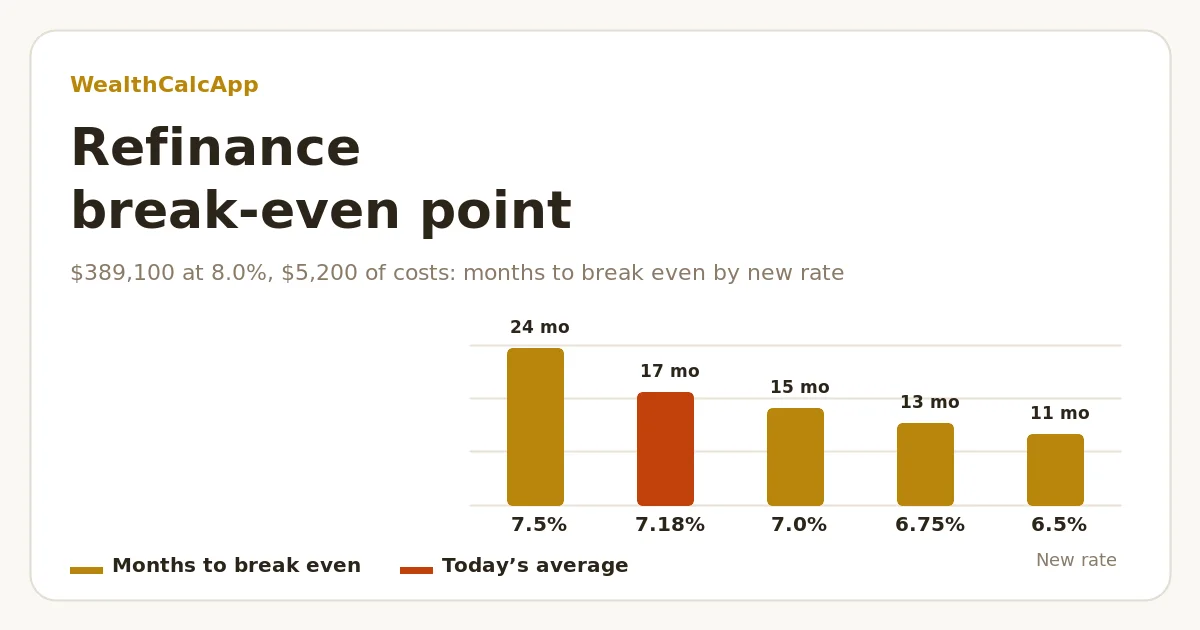
On 5 November 2026 the Freddie Mac average 30-year fixed rate was 7.18%. It has moved between 5.98% in late February and 7.40% in early October this year, so who benefits depends heavily on when you borrowed:
| New rate (30 years) | Monthly saving | Break-even | Ahead after 5 years |
|---|---|---|---|
| 7.50% | $214 | 24 months | $3,551 |
| 7.25% | $281 | 19 months | $8,457 |
| 7.18% (average) | $299 | 17 months | $9,830 |
| 7.00% | $346 | 15 months | $13,358 |
| 6.75% | $411 | 13 months | $18,254 |
| 6.50% | $476 | 11 months | $23,143 |
The table uses the example’s $389,100 balance at 8.0% and $5,200 of costs. If you are in that position, a refinance already makes sense at today’s rates, as long as you protect yourself from the term reset. If you borrowed at 7.79%, the 2023 average, a refinance to 7.18% saves $244 a month and breaks even in about 21 months, though over a fresh 30 years it costs more in total. And if you bought or refinanced in the first half of 2026 at around 6% to 6.5%, there is nothing to gain until rates fall well below that.
Limits worth knowing
- It ignores the time value of money. $5,200 paid today is worth more than $5,200 of savings spread over 15 months. With short break-evens this hardly matters; with seven-year ones it does.
- Taxes shift the numbers slightly. If you itemize, a lower rate also means a smaller mortgage interest deduction, and IRS rules spread the deduction of refinance points over the life of the loan. With a 2026 standard deduction of $32,200 for married couples, most households are not affected.
- Approval is not guaranteed. You need to qualify again: income, credit score, debt-to-income ratio and an appraisal that supports at least 20% equity for the best pricing.
- Rate quotes expire. A quote is only firm once the rate is locked, typically for 30 to 60 days; compare offers on the same day.
- It cannot predict your plans. A job move or a growing family can turn a 40-month break-even into a loss. Be honest about how long you will stay.
References
- Freddie Mac — Primary Mortgage Market Survey (weekly average rates)
- Consumer Financial Protection Bureau — Loan Estimate explainer
- IRS — Publication 936, Home Mortgage Interest Deduction
Frequently asked questions
Passionate about finance and investing, with more than 6 years of hands-on experience in the crypto world. He shares analysis and financial education on his YouTube channel, Cripto Adicto.
Watch on YouTube →Keep reading
Compare your two loans
Enter your balance, rate and remaining term, then the new offer, to see both monthly payments and the total interest side by side.
Open the Loan Calculator →