
How Much House Can I Afford? Lender Rules vs a Budget You Can Live With


Most people answer this question backwards. They find a home they love, then ask a bank whether they can borrow enough for it. The bank usually says yes — lenders are paid to lend — and the real question gets skipped: what price still lets you save, absorb a repair bill and sleep at night? This guide works it out in the right order: first the limits a lender applies, then the cash you need on the day, then the budget that fits your actual life. Every figure uses the same maths as our mortgage affordability calculator, so you can check each one yourself.
The short answer: three limits, and the lowest wins
Your maximum price is set by whichever of these runs out first:
- Income. Lenders cap the share of your gross income that can go on housing and debt payments. In the US the classic guideline is the 28/36 rule.
- Cash. You need a down payment, closing costs and a cushion left over. A great income with no savings still buys nothing.
- Your own budget. The payment has to sit alongside retirement saving, childcare, holidays and everything else a lender’s ratio never sees.
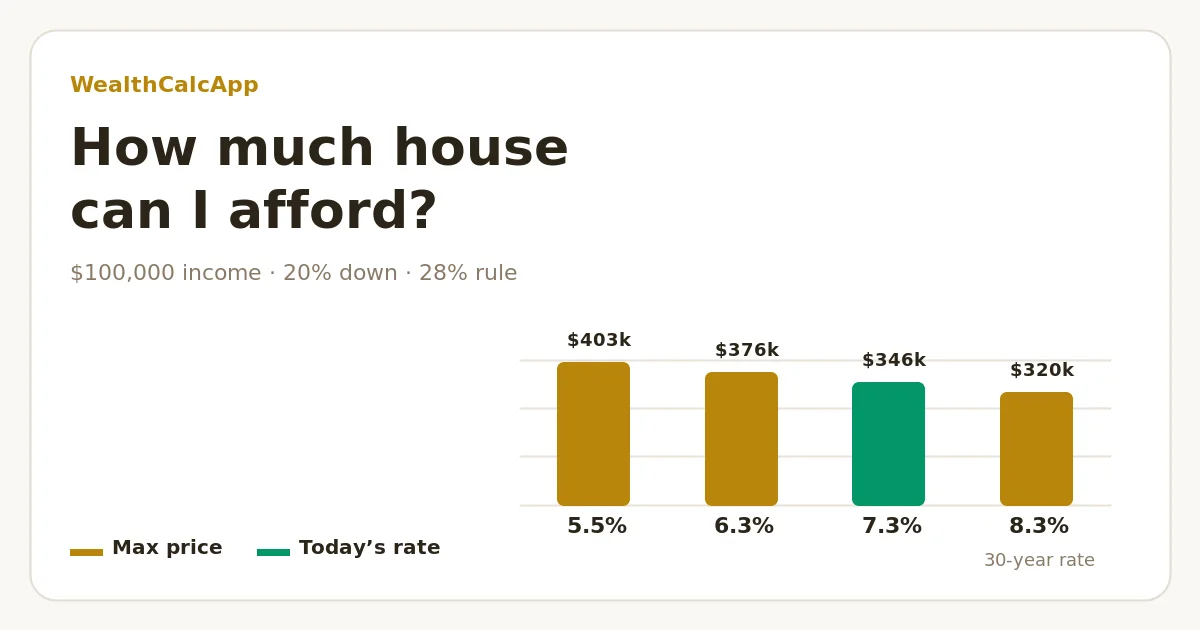
With a $100,000 household income, $500 a month of other debt payments, 20% down and a 30-year fixed rate of 7.3%, the lender’s limit works out at about $346,000. Whether that is your limit is a separate question, and the rest of this article answers both.
The 28/36 rule and your debt-to-income ratio
Your debt-to-income ratio (DTI) is your total monthly debt payments divided by your gross monthly income — what you earn before tax. The Consumer Financial Protection Bureau uses exactly this definition, and the 28/36 rule turns it into two caps:
- Front-end ratio, 28%. Housing costs — principal, interest, property tax and insurance (PITI), plus HOA fees and mortgage insurance if you have them — should stay at or below 28% of gross income.
- Back-end ratio, 36%. Housing plus every other debt payment (car loan, student loans, card minimums) should stay at or below 36%.
Both caps apply at once and the stricter one sets your limit. People with small debts usually hit the 28% cap first; people with a car loan and student debt hit the 36% cap first. The rule is a guideline, not a law: many lenders approve back-end ratios of 43% or more, and government-backed loans can go higher with strong compensating factors. Being approved at 45% does not make living at 45% a good idea.
Here is the whole test on one card. Swap in your own numbers:
[GROSS MONTHLY INCOME] × 0.36 − [OTHER MONTHLY DEBT PAYMENTS] = [CAP B: HOUSING AFTER DEBTS]
Lower of A and B = [MAXIMUM MONTHLY HOUSING PAYMENT]
For $8,333 a month (a $100,000 salary) and $500 of other debts, cap A is $2,333 and cap B is $3,000 − $500 = $2,500. Cap A is lower, so the maximum housing payment is $2,333 a month, with taxes and insurance included.
From monthly payment to home price: a worked example
A monthly payment becomes a price once you fix four things: the rate, the term, the down payment and the yearly cost of property tax and insurance. The assumptions here: a 30-year fixed loan at 7.3% (Freddie Mac’s weekly average was 7.32% on 22 October 2026), 20% down, and tax plus insurance at 1.5% of the home’s value a year — a middle-of-the-road figure; your county may be half that or double it.
| Using the 28% cap | Using the 36% cap | |
|---|---|---|
| Maximum housing payment | $2,333 | $2,500 |
| …of which principal and interest | $1,900 | $2,036 |
| …of which tax and insurance | $433 | $464 |
| Loan amount | $277,166 | $296,961 |
| Down payment (20%) | $69,291 | $74,240 |
| Maximum price | $346,457 | $371,201 |
So the lender’s ceiling in this example is about $346,000, set by the 28% cap. Notice what that means: paying off the $500-a-month car loan would not raise it at all, because the 28% cap still binds. That is worth knowing before you throw savings at the wrong debt. If your debts were larger and the 36% cap were the binding one, every $100 of monthly debt you cleared would add about $14,800 of buying power.
You can open this exact scenario in the calculator and change any input. The calculator applies one ratio at a time, so run it twice: 28% with zero debts for the front-end test, then 36% with your real debts for the back-end test, and keep the lower price.
How interest rates change your budget
Nothing moves the answer faster than the rate. Same income, same 20% down, same 28% cap:
| 30-year rate | Maximum price | Compared with 7.3% |
|---|---|---|
| 5.5% | $402,817 | +$56,360 |
| 6.3% | $376,221 | +$29,764 |
| 7.3% | $346,457 | — |
| 8.3% | $320,136 | −$26,321 |
At these levels each percentage point is worth roughly 8% of your buying power. Two practical consequences follow. First, a better rate is real money: getting quotes from three to five lenders on the same day is one of the best-paid hours you will ever spend, and our guide to getting a good mortgage rate shows how. Second, don’t budget on the rate you hope for. “Marry the house, date the rate” assumes you will be able to refinance later. You might not, so make sure today’s payment works on its own.
The cash you need on closing day
The income test tells you what you can borrow; the cash test often decides what you can buy. Plan for three pots of money:
- Down payment. 20% avoids private mortgage insurance (PMI) on a conventional loan. Minimums are lower — 3% on some conventional loans, 3.5% on FHA loans — but a smaller deposit means a bigger loan, mortgage insurance on top and less equity if prices fall.
- Closing costs. Typically 2–5% of the price: lender fees, appraisal, title insurance, transfer taxes and prepaid items such as the first year of insurance.
- Reserves. Money still in the bank after you get the keys. Lenders may want to see a couple of months of payments; you should want more, because the first year of ownership has a habit of producing a failed water heater.
For the $346,000 home that means $69,300 down, $7,000–$17,000 of closing costs and a cushion of at least three months of total spending. Call it $90,000–$100,000 of cash in all.
With only 10% down, the same income supports a lower price — about $314,000 instead of $346,000 — because the bigger loan eats more of the payment. And that is before PMI, which commonly costs somewhere between 0.3% and 1.5% of the loan a year; at 0.7% it would add about $165 a month. A smaller deposit gets you in sooner. It does not get you more house.
Your reserves shouldn’t sit next to your emergency fund — they are your emergency fund. Our emergency fund guide explains how to size it; as a new homeowner, aim for the upper end of the range.
The bank’s maximum vs a budget you can live with
Lender ratios use gross income and ignore everything except debt payments. They don’t know that you pay for childcare, that you want to retire before 70 or that half your pay is commission. So run a second test from the bottom up, using take-home pay:
− [ESSENTIAL COSTS EXCEPT HOUSING] (food, transport, childcare, utilities, insurance)
− [SAVINGS YOU WON’T CUT] (retirement, emergency fund top-ups)
− [BUFFER: 10% OF TAKE-HOME PAY]
= [THE MOST YOU SHOULD SPEND ON HOUSING EACH MONTH]
Example: $6,200 take-home, $2,300 of essentials, $900 into retirement and a $620 buffer leaves $2,380 — close to the lender’s $2,333, so this household can borrow the maximum and still save. Add $1,200 a month of childcare and the honest answer drops to $1,180, roughly half the bank’s figure. The bank would still lend the full amount. That gap is exactly where “house poor” comes from.
Then stress-test the number. Could you keep paying it on one income for six months? If the rate is adjustable, could you pay it two points higher? Would a $10,000 roof go on a credit card? If any answer is no, aim lower. Our budget calculator helps you pin down the real monthly figures.
Five ways to afford more without stretching
- Clear the debt that actually binds. Paying off a car loan only raises your limit if the 36% cap is the one you hit. Run both tests first.
- Improve your credit score. On a $277,000 loan, half a percentage point is worth about $93 a month — some $33,000 over 30 years. Our credit score guide covers the quickest fixes, starting with card utilisation.
- Save a bigger deposit. It lowers the loan, can remove PMI and often earns a better rate.
- Shop the rate, and understand points. Paying discount points can make sense if you will keep the loan for many years; our mortgage tips explain the break-even maths.
- Compare total monthly cost, not price. A cheaper home with high property tax or HOA fees can cost more each month than a pricier one. Watch the term, too: a 15-year loan builds equity fast, but on the same $2,333 budget it supports about $282,000 (assuming a 6.6% 15-year rate) instead of $346,000.
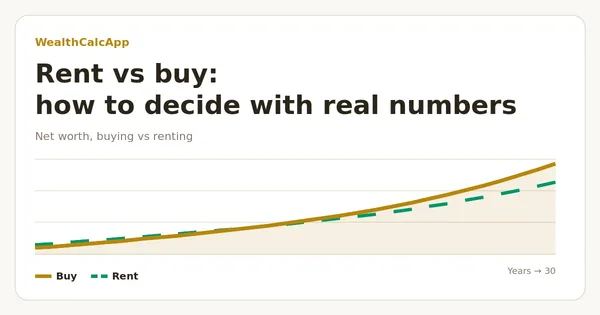
And sometimes the right answer is “not yet”. If the price you can live with doesn’t buy anything you would want to live in, renting for longer and investing the difference can leave you better off. Our rent vs buy guide shows how to compare the two fairly.
Limits worth knowing
- Rules of thumb are averages. 28/36 can be too loose for a family with childcare costs and too strict for a high earner with no debts and a large deposit.
- The calculator keeps things simple on purpose. It assumes a fixed payment and a flat tax-and-insurance percentage. It leaves out PMI, HOA fees, maintenance (budget 1–2% of the home’s value a year) and insurance premiums, which have risen sharply in some states.
- It doesn’t predict approval. Lenders also weigh your credit score, job history, the property itself and their own internal rules.
- It can’t tell you whether buying is wise. Affordability says what you can pay, not whether owning beats renting where you live.
- It isn’t personal advice. For a final decision, talk to more than one lender and, if you can, a fee-only financial adviser.
References
- Consumer Financial Protection Bureau — What is a debt-to-income ratio?
- Freddie Mac Primary Mortgage Market Survey via FRED — 30-Year Fixed Rate Mortgage Average
- Wikipedia — Debt-to-income ratio
Frequently asked questions
Passionate about finance and investing, with more than 6 years of hands-on experience in the crypto world. He shares analysis and financial education on his YouTube channel, Cripto Adicto.
Watch on YouTube →Keep reading

Find your maximum home price
Enter your income, debts, rate, term and down payment to see the price a lender’s rules allow — and the monthly payment behind it.
Open the Affordability Calculator →