
How to Calculate a Mortgage Payment: The Formula, the Schedule and the Real Monthly Cost


Your lender will tell you the monthly payment, but it helps to know where the number comes from. Once you can calculate it yourself, you can check a loan estimate, see what a lower rate or a shorter term is really worth, and understand why, ten years in, you still owe most of what you borrowed. This guide covers the standard formula, works through a $320,000 loan step by step, shows how amortization splits each payment between interest and principal, and adds the costs the formula leaves out: property tax, insurance and PMI. The figures use the same maths as our mortgage calculator.
The short answer: the mortgage payment formula
Every fixed-rate mortgage in the US is a fully amortizing loan: the same payment every month, worked out so that the last payment brings the balance to exactly zero. The payment depends on just three numbers.
P = [LOAN AMOUNT] (the home price minus your down payment)
r = [ANNUAL INTEREST RATE] ÷ 12 (as a decimal: 6.5% → 0.065 ÷ 12 = 0.0054167)
n = [LOAN TERM IN YEARS] × 12 (30 years → 360 payments)
M is the monthly principal and interest payment, often written P&I. It is not the whole cheque you send each month: property tax, homeowners insurance and, with a small down payment, mortgage insurance usually come on top. We add those in a later section.
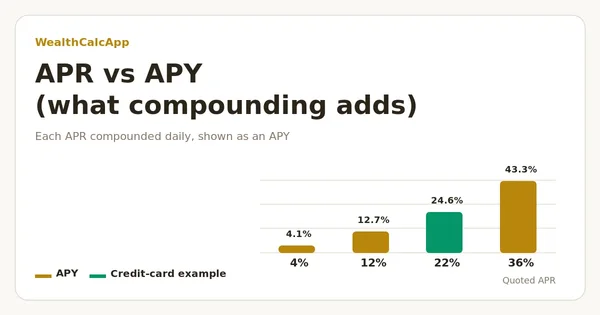
Use the interest rate from your loan estimate, not the APR. The APR folds the lender’s fees into a single comparison figure, but your payment is calculated on the note rate. Our guide to APR vs APY explains the difference.
A worked example: $320,000 over 30 years
Say you buy a $400,000 home with 20% down. You borrow $320,000 at a fixed 6.5% for 30 years.
(1 + r)^n = 1.00541667^360 = 6.9918
M = 320,000 × 0.00541667 × 6.9918 ÷ (6.9918 − 1) = $2,022.62 a month
Over 30 years you make 360 payments of $2,022.62, a total of $728,142. Of that, $320,000 repays the loan and $408,142 is interest, more than the amount borrowed. That is normal for a 30-year loan at this rate, and it is why the rate and the term matter so much.
A quick way to sanity-check any quote is the payment per $100,000 borrowed. At 6.5% over 30 years it is $632.07, so a $320,000 loan is 3.2 × $632.07 = $2,022.62. At 5.5% it is $567.79 per $100,000; at 7.5%, $699.21.
You can open this example in the mortgage calculator and change any of the inputs to see the payment, total interest and year-by-year schedule update.
How amortization works: where each payment goes
The payment stays the same, but what it pays for changes every month. Each month the lender charges interest on the balance you still owe, and whatever is left of the payment reduces the balance:
Principal this month = [MONTHLY PAYMENT] − interest this month
New balance = [BALANCE] − principal this month
| Month | Payment | Interest | Principal | Balance |
|---|---|---|---|---|
| 1 | $2,022.62 | $1,733.33 | $289.28 | $319,710.72 |
| 2 | $2,022.62 | $1,731.77 | $290.85 | $319,419.86 |
| 3 | $2,022.62 | $1,730.19 | $292.43 | $319,127.44 |
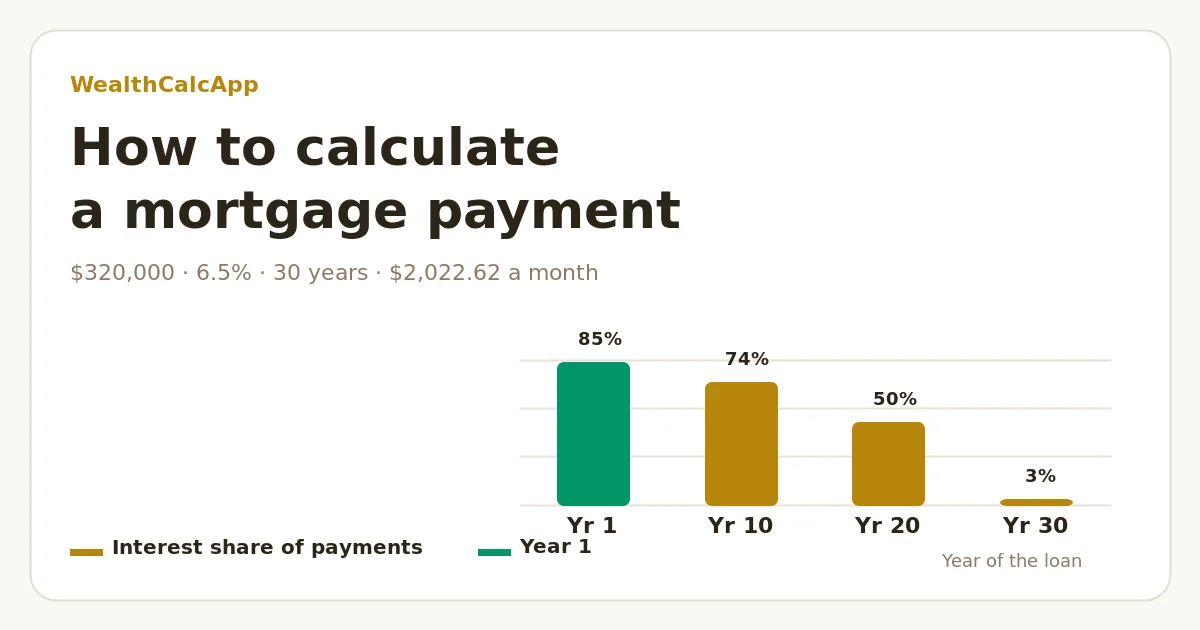
| 120 (year 10) | $2,022.62 | $1,472.43 | $550.18 | $271,283.60 |
| 233 (year 20) | $2,022.62 | $1,009.60 | $1,013.01 | $185,375.32 |
| 360 (last) | $2,022.62 | $10.90 | $2,011.72 | $0 |
In the first month, 86% of the payment is interest. Because the balance falls so slowly at first, the split changes slowly too: it takes until month 233, almost 20 years in, before more of each payment goes to principal than to interest. After ten years of payments you have repaid only $48,716, or 15% of the loan.
That has practical consequences. If you sell or refinance after five or ten years, most of what you paid went to interest, and your equity comes mainly from your down payment and any rise in the home’s value. It is also why extra payments made early in the loan save far more interest than the same money paid late.
Calculate it in Excel or Google Sheets
You don’t need to type the formula. Excel, Google Sheets and LibreOffice share the same financial functions. Enter the loan as a negative number so the results come out positive:
=IPMT([RATE]/12, [MONTH], [YEARS]*12, -[LOAN]) → interest in month 1 = 1,733.33
=PPMT([RATE]/12, [MONTH], [YEARS]*12, -[LOAN]) → principal in month 1 = 289.28
=CUMIPMT([RATE]/12, [YEARS]*12, [LOAN], 1, 12, 0) → interest in year 1 = −20,695
To build your own amortization schedule, make five columns: month, payment, interest, principal and balance. Put the loan amount in the first balance cell, calculate interest as the previous balance × rate ÷ 12, principal as the payment minus interest, and the new balance as the previous balance minus principal. Copy the row down 360 times; if the last balance is zero (or within a cent of it), the schedule is right.
From principal and interest to your real monthly payment (PITI)
Lenders usually describe the full payment as PITI: principal, interest, taxes and insurance. Most collect the last two through an escrow account: they add one-twelfth of your annual property tax and homeowners insurance to each payment and pay the bills for you when they fall due.
Example: $2,022.62 + $3,500 ÷ 12 + $1,200 ÷ 12 = $2,022.62 + $291.67 + $100.00 = $2,414.29
- Property tax varies enormously by state and county, from well under 1% of the home’s value a year to over 2%. Look up the actual tax bill on the listing or the county website rather than guessing.
- Homeowners insurance has risen sharply in some states. Get a quote before you make an offer, not after.
- PMI applies to most conventional loans with less than 20% down. With 10% down on the same home you would borrow $360,000, raising P&I to $2,275.44 before PMI is added. You can ask for PMI to be removed once you reach 20% equity, and it ends automatically at 22% on the original schedule.
- HOA dues are usually paid separately, but lenders count them, and so should you.
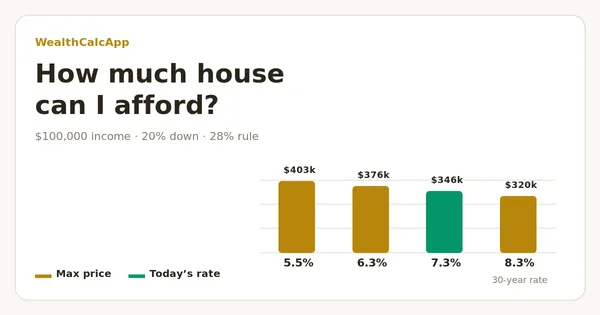
Because taxes and insurance change, the escrow part of your payment is reviewed every year, so even a fixed-rate mortgage payment can go up. Our guide on how much house you can afford shows how lenders compare the full PITI with your income.
What changes the payment: rate, term and down payment
With the formula in hand you can see what each lever is worth. On the same $320,000 loan:
| Rate (30 years) | Monthly P&I | Total interest |
|---|---|---|
| 5.5% | $1,816.92 | $334,093 |
| 6.5% | $2,022.62 | $408,142 |
| 7.5% | $2,237.49 | $485,495 |
Each percentage point moves the payment by roughly $210 a month and the lifetime interest by about $75,000. That is why it pays to get several quotes on the same day and compare them on the same basis; our guide to the best mortgage rates covers how.
| Term | Monthly P&I | Total interest |
|---|---|---|
| 30 years at 6.5% | $2,022.62 | $408,142 |
| 15 years at 6.5% | $2,787.54 | $181,758 |
| 15 years at 5.9% | $2,683.08 | $162,955 |
A 15-year loan costs $765 more a month at the same rate, but cuts the interest by $226,384, and 15-year rates are usually lower than 30-year ones, which widens the gap. The trade-off is flexibility: a 30-year loan with voluntary extra payments gives you a lower required payment if money gets tight.
Paying less interest: extra payments, biweekly plans and ARMs
Because interest is charged on the balance, anything that reduces the balance early saves interest for the rest of the loan. On the $320,000 example:
- $200 a month extra pays the loan off in 23 years and 5 months instead of 30, and saves $105,428 in interest.
- Biweekly payments (half the payment every two weeks) add up to 13 full payments a year instead of 12. That is the same as paying an extra $168.55 a month: the loan ends after 24 years and 2 months and you save $93,072. You can get the same result without signing up for a paid biweekly programme by adding one-twelfth to each monthly payment.
- One-off lump sums work the same way. Ask the servicer to apply them to principal, and check your note for a prepayment penalty; most US mortgages today don’t have one.
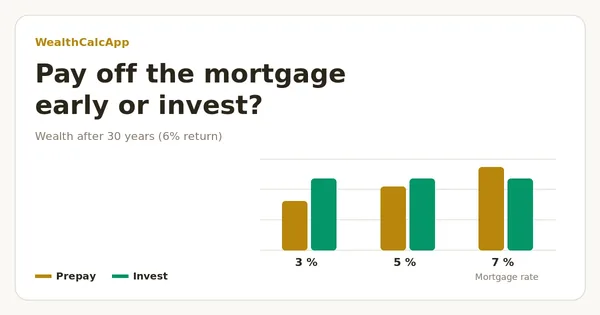
Whether extra payments beat investing the same money depends mainly on your rate; we run the numbers in pay off your mortgage early or invest. You can test any amount in the mortgage calculator with an extra $200 a month.
With an adjustable-rate mortgage, the formula is applied again at each reset, using the balance and the years left. Suppose the $320,000 loan starts at 6.5% and resets after five years, when you owe $299,555 with 25 years to go. At 7.5% the payment becomes $2,213.69 (+$191); at 8.5%, $2,412.10 (+$389). Run that worst case before you choose an ARM; our mortgage tips compare fixed and adjustable loans.
Limits worth knowing
- The formula assumes a fixed rate and on-time payments. ARMs, interest-only periods, missed payments and loan modifications all change the schedule.
- Lenders round. Payments are rounded to the cent and the final payment is adjusted, so your servicer’s schedule may differ from yours by a few dollars.
- Your first payment isn’t a normal one. Interest is paid in arrears, so at closing you prepay interest for the rest of that month, and the first regular payment is usually due a month or more later.
- Closing costs aren’t in the payment. Origination fees, points and title costs are paid upfront or rolled into the loan, which raises P, and with it, the payment.
- Our calculator simplifies. It treats tax and insurance as fixed amounts and doesn’t add PMI, so treat its total as an estimate, not a loan offer.
References
- Consumer Financial Protection Bureau — What is an escrow or impound account?
- Wikipedia — Mortgage calculator (the monthly payment formula)
- Wikipedia — Amortization schedule
Frequently asked questions
Passionate about finance and investing, with more than 6 years of hands-on experience in the crypto world. He shares analysis and financial education on his YouTube channel, Cripto Adicto.
Watch on YouTube →Keep reading
Calculate your own mortgage payment
Enter the price, down payment, rate and term to see the monthly payment, total interest and a year-by-year amortization schedule.
Open the Mortgage Calculator →