How to Calculate Rental Yield: Gross, Net and the Cash You Actually Keep


A listing that promises an 8% yield is usually telling you the truth, just not the whole of it. That figure is the gross rental yield: a year’s rent divided by the price, before a single bill is paid. What you keep after vacancy, property tax, insurance, repairs and management is often half as much, and a mortgage can turn it negative. This guide calculates rental yield step by step on one example, a $300,000 house let at $2,000 a month, from the quick gross figure to the net yield, the cap rate, the cash-on-cash return with a loan and the effect of tax, so you can compare a property with any other place your money could go.
The quick figure: gross rental yield
Gross yield is the number agents and listing sites quote, because it needs only two inputs:
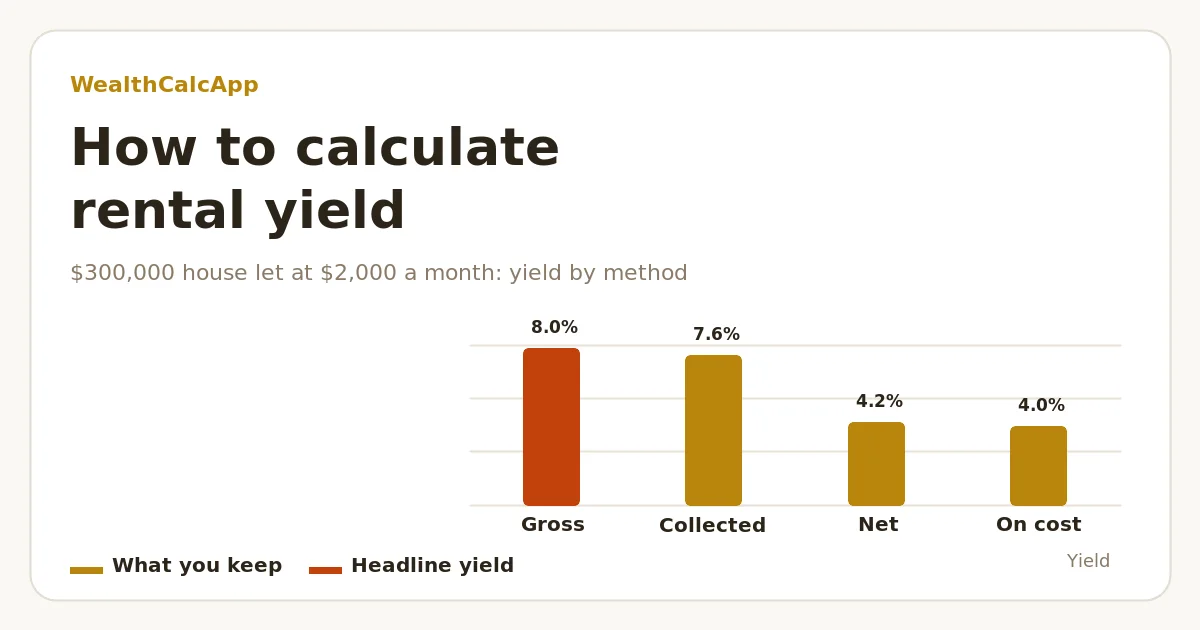
For the example house, $2,000 × 12 = $24,000 of rent a year, and $24,000 ÷ $300,000 = 8.0%. It is useful for one job: screening. If you are comparing twenty listings in an evening, gross yield tells you which ones are worth a closer look. The table shows how quickly it moves with the rent:
| Purchase price | Monthly rent | Annual rent | Gross yield |
|---|---|---|---|
| $200,000 | $1,500 | $18,000 | 9.0% |
| $300,000 | $2,000 | $24,000 | 8.0% |
| $300,000 | $1,750 | $21,000 | 7.0% |
| $450,000 | $2,500 | $30,000 | 6.7% |
| $600,000 | $3,000 | $36,000 | 6.0% |
A related shortcut is the 1% rule: the monthly rent should be at least 1% of the price. At $2,000 on $300,000 the example manages 0.67%, so it fails. The rule dates from cheaper decades and few homes in expensive metro areas pass it today, but it is still a fair warning sign: the further below 1% a property sits, the less room the rent leaves for costs and interest.
Net rental yield: subtract the running costs
Net yield is the figure that matters, because it is based on the money left after the property has paid its own bills. Investors call that amount net operating income (NOI):
− [MAINTENANCE] − [MANAGEMENT] − [HOA FEES] − [UTILITIES YOU PAY]
Net rental yield = NOI ÷ [PURCHASE PRICE] × 100
Mortgage payments are deliberately left out; financing comes later. For the example house:
- Vacancy: allow 5% of the rent for the weeks between tenants and the odd late payer, $1,200. Rent actually collected: $22,800.
- Property tax: $3,600 (1.2% of the price; check the county’s real rate and whether a sale triggers a reassessment).
- Landlord insurance: $1,800, which costs more than a homeowner policy.
- Maintenance and repairs: $3,000, or 1% of the value a year, more for an older house.
- Property management: 8% of collected rent, $1,824. If you plan to manage it yourself, still count it: your time has a price, and you may not want to do it forever.
Costs come to $10,224, so NOI is $22,800 − $10,224 = $12,576 and the net yield is $12,576 ÷ $300,000 = 4.19%, barely half the headline figure. A quick sanity check is the 50% rule: expect vacancy and running costs to absorb about half the gross rent. Here they take 47.6%, so the estimate is realistic rather than optimistic.
Two costs are easy to miss. A condo or a house in a planned community comes with HOA fees, often $200 to $400 a month, which can cut a net yield by a full percentage point on their own. And big-ticket replacements, a roof, a furnace, a water heater, do not appear in a typical year’s repairs at all. Many landlords set aside a separate capital reserve of 5% of the rent for them; in the example that would be another $1,200 a year and would take the net yield to 3.8%.
Use what you paid, not just the price
The price is not the whole investment. Closing costs, inspections and the repairs needed before the first tenant moves in are money you have tied up in the property, and they belong in the denominator:
With $9,000 of closing costs and $6,000 of repairs and furnishing for the let, the total is $315,000 and the yield falls to 3.99%. Gross yield on the same basis is 7.6%. The difference looks small, but it compounds: you pay those costs again, in some form, every time you buy.
This is also why yields quoted for different properties are often not comparable. One seller works from the price, another from the price plus costs, a third from an estimated current value. If you are comparing a rental with shares or funds, always use the total cash you put in, which is how a return on investment calculation treats any other asset.
Net yield, cap rate and cash-on-cash return
Three measures of rental return are used, sometimes interchangeably, and it pays to know which one you are looking at:
| Measure | Formula | Example |
|---|---|---|
| Net yield on cost | NOI ÷ total cost | 3.99% |
| Cap rate | NOI ÷ current market value | 4.19% |
| Cash-on-cash return | Cash flow after debt service ÷ cash invested | −4.99% with a 25% deposit |
The capitalisation rate is NOI divided by what the property is worth today, so it describes the property, not your deal. Two buyers of the same house share its cap rate, whatever they paid or borrowed. It is how commercial investors price buildings: a $12,576 NOI at a 5% market cap rate implies a value of about $251,500.
Cash-on-cash return describes your deal. It divides the cash that reaches your account after the mortgage by the cash you put in, which is why it can be much higher or, as the next section shows, negative.
What a mortgage does to the return
Suppose you buy the house with 25% down and a 30-year loan at 6.5%. You invest $75,000 plus $15,000 of costs, $90,000 in all, and borrow $225,000:
Cash-on-cash return = annual cash flow ÷ [CASH INVESTED] × 100
The monthly payment is $1,422, or $17,066 a year. NOI is $12,576, so the property loses $4,490 a year, a cash-on-cash return of −4.99%. You can check the payment with the mortgage calculator, filled in with this example; our guide on how to calculate a mortgage payment explains the formula.
The rule behind this is simple. Borrowing raises your return only when the property earns more than the debt costs. With a 4.2% cap rate and a 6.5% mortgage, every borrowed dollar costs more than it earns: that is negative leverage. Paying cash gives a 3.99% cash-on-cash return; borrowing at a rate below the cap rate, or buying at a higher cap rate, is what makes a loan worthwhile.
Two things soften the picture. About $2,515 of the first year’s payments repays principal, which is equity you keep rather than a cost. And rents tend to rise while a fixed payment does not. But neither pays the bills this year, and a property that needs $375 a month from your salary has to be affordable before it can be profitable.
Tax: depreciation and the after-tax yield
Rental income is taxable, but the IRS lets you deduct operating costs, mortgage interest and depreciation: the cost of the building, not the land, spread over 27.5 years for residential property.
Taxable rental income = NOI − [MORTGAGE INTEREST] − depreciation
If the building accounts for 80% of $309,000, depreciation is about $8,989 a year. A cash buyer then pays tax on only $3,587 of the $12,576 NOI; at a 22% bracket that is $789, leaving an after-tax yield of 3.74% on cost. With the mortgage, interest of $14,551 in year one produces a paper loss, which passive activity rules let you offset against salary only within a $25,000 allowance that phases out between $100,000 and $150,000 of modified adjusted gross income.
Depreciation is a deferral rather than a gift. When you sell, the depreciation you claimed is taxed at up to 25%, on top of the normal tax on any price gain, which our guide to calculating capital gains tax walks through.
What is a good rental yield?
There is no universal number, because yield moves inversely with price growth and risk. Expensive coastal cities often show gross yields of 4–5% and lean on appreciation; cheaper Midwestern markets can show 9–10% with more vacancy, repairs and slower growth. Three comparisons are more useful than a rule:
- Against safe money. If a Treasury bill or a high-yield savings account pays close to the property’s net yield, the property has to earn its risk, illiquidity and the work of being a landlord through growth.
- Against inflation. A 4% net yield in a year of 3–4% inflation is a near-zero real return on the income alone.
- Against your own cost of debt. As the previous section showed, a net yield below the mortgage rate means the loan makes the deal worse.
Yield is also only the income half of the return. If the house rises 3% in a year, that adds $9,000 to the $12,576 of NOI, for a total return of 6.85% on cost before tax and selling costs. You can test scenarios like that with the ROI calculator, filled in with this example. For the bigger picture of rentals versus REITs and other ways in, see our guide to real estate investing.
Limits worth knowing
- Yield is a snapshot. It measures one year at today’s rent and costs; a new roof or a six-month vacancy can wipe out several years of the difference between two properties.
- Estimates are only as good as their inputs. Insurance premiums and property taxes have risen sharply in some states, so use current quotes, not last year’s figures.
- It ignores your time. A self-managed rental that yields 1% more than a managed one may not be worth the calls at midnight.
- It is not liquid. Selling takes months and costs 6–10% of the price in commissions and closing costs, which a yield figure never shows.
- Local rules matter. Rent control, registration, licensing and eviction rules vary by city and state and can cap the rent your calculation assumes.
References
- IRS — Publication 527, Residential Rental Property
- Wikipedia — Capitalization rate
- Wikipedia — Net operating income
Frequently asked questions
Passionate about finance and investing, with more than 6 years of hands-on experience in the crypto world. He shares analysis and financial education on his YouTube channel, Cripto Adicto.
Watch on YouTube →Keep reading

Test your rental numbers
Enter what you put in and what the property is worth after rent and costs to see the total and annual return, then compare it with other investments.
Open the ROI Calculator →