
Pay Off Your Mortgage Early or Invest? The Math, Not the Myth


You have a few hundred dollars left over each month. Should they go into extra mortgage payments, or into an index fund? Both build wealth, and both camps defend their side passionately: one swears by the freedom of owning your home outright, the other points out that markets have historically returned more than most mortgage rates. The honest answer depends on four things — your mortgage rate, the return you can realistically expect, taxes and how much risk you can stomach. Here is how to weigh them with real numbers.
The one rule that settles most cases
Every extra dollar you pay on a mortgage “earns” exactly your mortgage rate, because it is a dollar of debt you will never pay interest on again. That return is guaranteed, it arrives no matter what markets do, and — unless you itemise and deduct mortgage interest, which most households no longer do — it is tax-free. Investing offers a higher expected return, but it is uncertain and usually taxed.
So the rule of thumb is simple: if your mortgage rate is higher than the after-tax return you can realistically expect, prepay; if it is clearly lower, invest. In between, it comes down to risk tolerance and priorities.
A worked example: $300 a month on a 6.5% mortgage
Take a $280,000 loan at 6.5% for 30 years. Principal and interest are $1,770 a month. Paying an extra $300 every month clears the loan in about 20.4 years instead of 30 and saves $131,512 in interest. The alternative is to invest that $300 every month instead.
To compare fairly, both households spend the same amount each month: the prepayer, once the mortgage is gone, invests the full $2,070 it no longer pays to the bank. Here is the investment portfolio each one has after 30 years — when both own the house outright:
| Investment return | Prepay first, then invest | Invest the $300 from day one | After 15% tax on gains |
|---|---|---|---|
| 4% a year | $288,460 | $205,581 | Prepay wins ($280,895 vs $190,944) |
| 6% a year | $318,020 | $292,354 | Prepay wins ($306,021 vs $264,701) |
| 8% a year | $350,902 | $422,565 | Invest wins ($375,380 vs $333,970) |
With a 6.5% mortgage, prepaying beats investing unless your portfolio earns around 7% or more a year — and then you are taking stock-market risk to beat a guaranteed 6.5%. You can test your own loan in the mortgage calculator: open Advanced options and add an extra monthly payment to see the interest and years you save.
Your mortgage rate decides most of it
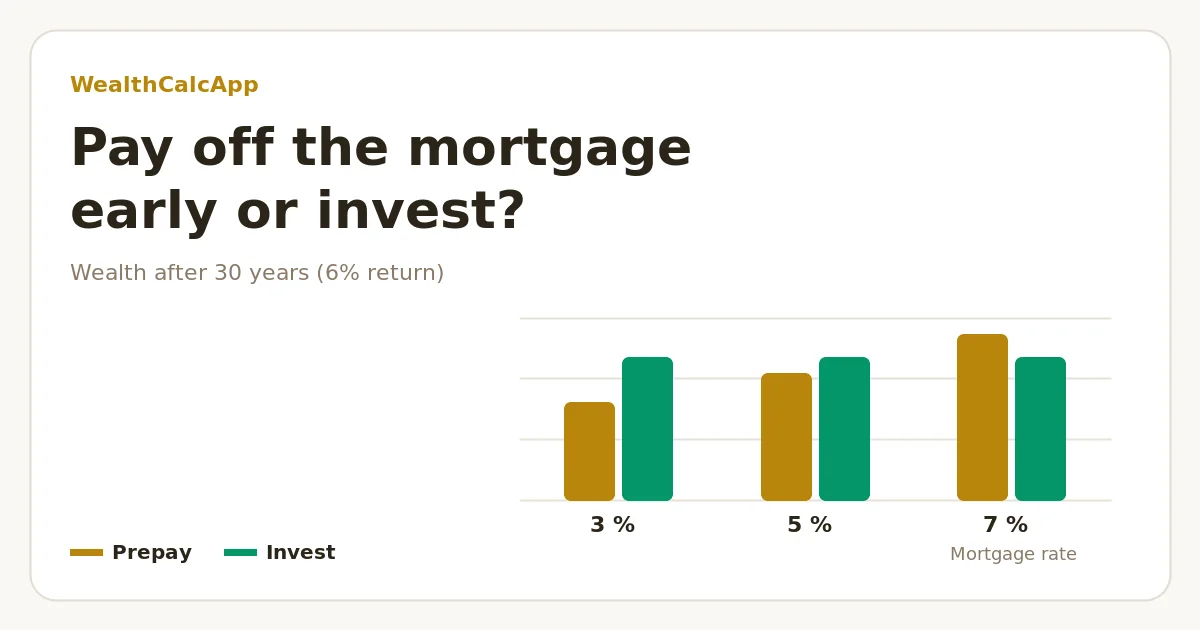
Same household, a $250,000 loan over 30 years and $300 a month to spare. Portfolio after 30 years with a 6% investment return, before tax:
| Mortgage rate | Prepay first | Invest from day one | Winner at 6% returns |
|---|---|---|---|
| 3% | $201,010 | $292,354 | Invest, by a wide margin |
| 5% | $260,952 | $292,354 | Invest, narrowly |
| 7% | $340,331 | $292,354 | Prepay |
Borrowers who locked in 3% mortgages in 2020–2021 are effectively borrowing below inflation; prepaying them is rarely the best use of cash. Recent buyers paying 6.5–7% face a very different calculation: a guaranteed, tax-free 7% is hard to beat.
What the spreadsheet leaves out
- Liquidity. Money paid into your house is hard to get back in an emergency — you would need a sale or a new loan. Build an emergency fund before you prepay anything.
- Free money first. An employer 401(k) match is an instant 50–100% return; take all of it before prepaying a mortgage. Pay off credit cards and other high-interest debt first, too.
- Tax-advantaged accounts. Investing through a 401(k), IRA or Roth IRA shields growth from tax, which tips the balance towards investing.
- Inflation. A fixed-rate mortgage gets cheaper in real terms every year inflation runs; at 3% inflation a 3% loan costs roughly nothing in real terms.
- Peace of mind. Being mortgage-free before retirement slashes the income you need. For many people, that certainty is worth more than a slightly higher expected return.
- Penalties and options. Most US mortgages have no prepayment penalty (where allowed, they are capped and expire after three years). If you want a lower payment rather than a shorter loan, ask your lender about a recast.
A balanced approach
You do not have to choose one side. Many people split the surplus — say half to extra principal and half to investments — which captures part of the guaranteed return while keeping money liquid and invested. Revisit the split when rates change: if you can refinance lower, investing becomes more attractive; if your rate is high, lean towards prepaying.
Run your own numbers
Model the extra payment in the mortgage calculator or the loan calculator, then see what the same monthly amount grows to in the compound interest calculator. If the investment only wins with returns you would not bet on, the guaranteed one is probably your answer.
Frequently asked questions
See what an extra payment saves you
Add an extra monthly payment to your mortgage and see the interest saved and how many years earlier you will be debt-free.
Open the Mortgage Calculator →
Passionate about finance and investing, with more than 6 years of hands-on experience in the crypto world. He shares analysis and financial education on his YouTube channel, Cripto Adicto.
Watch on YouTube →